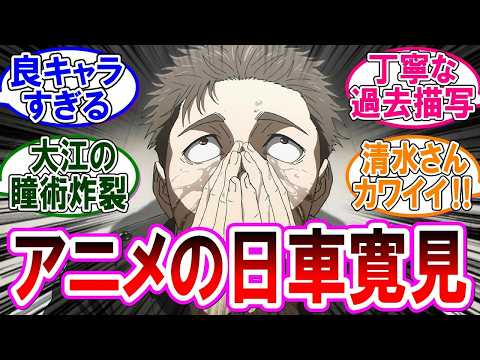
▶ Watch the original YouTube video
Jujutsu Kaisen Episode 55 Analysis: How the Anime Elevated Hiromi’s Character Beyond the Manga
Episode 55 of Jujutsu Kaisen presents a masterful adaptation of the Hiromi character arc, with restructured narrative pacing and exceptional voice acting that amplifies the source material’s psychological depth. The episode successfully visualizes Hiromi’s descent into madness while maintaining his humanity through carefully crafted character moments.
- What Happened
- Why It Matters
- Background
- Key Points
- Narrative Structure and Adaptation Choices
- Voice Acting and Character Interpretation
- Thematic Analysis: Perfectionism and Madness
- Character Comparison Framework
- The Fencing Paradox
- The Role of Shimizu Remi
- Visual Representation of Psychological States
- Reception and Critical Response
- Insights and Broader Implications
- Outstanding Questions and Future Expectations
- Conclusion
What Happened
Episode 55 of Jujutsu Kaisen adapts the backstory of Hiromi, a major antagonist introduced during the Shibuya Incident arc. The episode restructures the narrative sequence from the original manga, presenting Hiromi’s past chronologically rather than through fragmented exposition. Key scenes include his middle school encounter with Itadori, his development as a fencing prodigy, and his introduction to jujutsu sorcery. The episode culminates in depicting Hiromi’s Domain Expansion and his undefeated record of 20 consecutive victories in the Shibuya Incident.
Why It Matters
Character adaptation quality directly impacts viewer engagement and emotional investment in anime series. Episode 55 demonstrates how thoughtful structural changes and voice acting can enhance source material rather than diminish it. The episode’s success in portraying Hiromi’s psychological complexity—his pursuit of perfection coupled with his awareness of his own descent into madness—establishes a benchmark for how anime can improve upon manga storytelling through visual and auditory mediums. This approach proves particularly significant for understanding Jujutsu Kaisen’s thematic exploration of genius and its destructive potential.
Background
Jujutsu Kaisen has established itself as a series distinguished by its character depth and psychological complexity. The narrative introduces multiple genius-level characters, including Gojo Satoru and Fushiguro Megumi, each pursuing different paths with their exceptional abilities. Hiromi represents a distinct archetype: a prodigy aware of his own psychological deterioration yet unable to arrest it. In the manga, Hiromi’s backstory emerges gradually through exposition during combat sequences. The anime adaptation chose to reorganize this information, presenting it as a cohesive character study that emphasizes the progression from talented youth to destabilized individual.
Key Points
- The anime restructures Hiromi’s backstory chronologically, improving narrative clarity and emotional impact compared to the manga’s fragmented approach
- Voice actor Sugita Tomokazu delivers nuanced performance work that captures both Hiromi’s genius and his psychological instability through subtle vocal modulation
- The addition of expanded scenes with Shimizu Remi reinforces Hiromi’s residual humanity, positioning her as the final anchor to his former self
- Visual representation of Hiromi’s Domain Expansion effectively communicates the manifestation of his internal chaos as external reality
- The episode emphasizes the contradiction between Hiromi’s fencing background—which demands dialogue with an opponent—and his Executioner’s Sword technique, which eliminates that possibility
- Hiromi’s perfect 20-0 record in the Shibuya Incident serves as a symbolic representation of his complete loss of humanity through absolute victory
Narrative Structure and Adaptation Choices
The original manga presents Hiromi’s background through exposition interwoven with combat sequences, requiring readers to piece together his character arc retrospectively. The anime adaptation implements a significant structural change: it presents Hiromi’s past as a linear narrative before depicting his present-day actions. This reorganization allows viewers to understand his psychological state before witnessing its manifestation in combat.
The middle school encounter scene between Hiromi and Itadori functions as a turning point in both versions, but the anime emphasizes this moment as the catalyst for Hiromi’s awakening to jujutsu sorcery. By positioning this scene earlier in the episode’s narrative flow, the adaptation creates a clear causal relationship between Hiromi’s discovery of his true talent and his subsequent psychological deterioration.
Voice Acting and Character Interpretation
Sugita Tomokazu’s vocal performance distinguishes the anime adaptation significantly. Known for roles ranging from Gintoki in Gintama to Motobe in Kengan Ashura, Sugita brings considerable range to Hiromi’s characterization. His performance captures the subtle shifts in Hiromi’s psychological state through vocal inflection rather than explicit dialogue. Particularly notable are the moments where Hiromi’s composure fractures, and his response to being called “Hiromi-san” by Shimizu, where minimal vocal change conveys maximum psychological significance.
Thematic Analysis: Perfectionism and Madness
Episode 55 visualizes what might be termed the “dark side of perfectionism.” Hiromi’s pursuit of absolute mastery across multiple disciplines—fencing, jujutsu, and strategic thinking—creates a psychological framework where anything less than perfection registers as failure. When placed in the Shibuya Incident environment, where his perfectionist standards can theoretically be maintained indefinitely through combat, Hiromi experiences a kind of psychological liberation through destruction.
The episode’s depiction of Hiromi’s Domain Expansion as a manifestation of his internal chaos represents a critical thematic moment. In Jujutsu Kaisen’s cosmology, Domain Expansion externalizes the sorcerer’s mental landscape. Hiromi’s domain, therefore, becomes a visual representation of his fractured psyche—a space where his obsession with perfection and control has transformed into something fundamentally destructive.
Character Comparison Framework
Hiromi vs. Light Yagami (Death Note): Both pursue absolute control through their respective abilities. However, Light maintains conviction in his righteousness, while Hiromi demonstrates awareness of his own madness without the capacity to arrest it.
Hiromi vs. Eren Yeager (Attack on Titan): Both experience transformative awakenings to their true power. Eren’s conflict centers on external enemies, while Hiromi’s conflict is fundamentally internal—a battle against his own psychological dissolution.
Hiromi vs. Gojo Satoru (Jujutsu Kaisen): Both possess exceptional talent and pursue systematic change within their respective domains. Gojo seeks to restructure jujutsu society’s hierarchies, while Hiromi finds satisfaction in the destruction inherent to his perfect victories.
The Fencing Paradox
A critical insight emerges from examining Hiromi’s background as a competitive fencer. Fencing fundamentally requires dialogue with an opponent—a mutual exchange of attacks and defenses that presupposes the opponent’s agency and responsiveness. Hiromi’s Executioner’s Sword technique, conversely, eliminates this dialogue entirely. The technique guarantees death to anything it cuts, removing the element of competition that defines fencing.
This contradiction—between Hiromi’s formative discipline, which demands opponent engagement, and his ultimate technique, which eliminates that engagement—encapsulates his psychological paradox. He simultaneously seeks perfect dialogue with an opponent and perfect, unilateral dominance. Episode 55 visualizes this contradiction through scenes where Hiromi seeks support (his interaction with Shimizu) while simultaneously pursuing absolute control.
The Role of Shimizu Remi
In the manga, Shimizu Remi’s character remains relatively underdeveloped. The anime adaptation elevates her significance by positioning her as “the final barrier to Hiromi’s humanity.” The scene where Hiromi purchases a cat for Shimizu—implied in the manga but explicitly visualized in the anime—demonstrates that Hiromi retains capacity for human connection and consideration, even as his psychological state deteriorates.
This addition serves a crucial narrative function: it prevents Hiromi from becoming a one-dimensional villain. By maintaining evidence of his residual humanity, the adaptation preserves the tragedy inherent to his character. Hiromi is not a monster who was always destined for madness; rather, he is a human whose pursuit of perfection has systematically eroded his capacity for connection.
Visual Representation of Psychological States
The episode employs several visual techniques to communicate Hiromi’s psychological condition. The bathing scene, which might appear arbitrary without context, functions as a symbolic representation of Hiromi’s attempt to cleanse himself of his awareness of his own madness. The water imagery suggests both purification and drowning—Hiromi’s simultaneous desire to escape his psychological state and his inability to do so.
The Domain Expansion sequence visualizes the externalization of Hiromi’s internal chaos. The geometric precision of the domain’s construction contrasts sharply with the destructive potential it contains, visually representing the paradox of Hiromi’s character: perfect control that manifests as perfect destruction.
Reception and Critical Response
Following the episode’s broadcast, online communities demonstrated substantial engagement with Hiromi’s character arc. Twitter discussions frequently referenced the phrase “Hiromi stands out even in the anime adaptation,” with multiple users noting that the anime enhanced the character’s appeal beyond the manga version. Sugita Tomokazu’s performance received particular praise, with viewers highlighting the effectiveness of his subtle vocal work in conveying psychological complexity.
Discussion forums focused on the structural changes to Hiromi’s backstory, with the majority of manga readers approving the reordering of narrative elements. This represents a notable exception to the typical pattern where structural changes to source material generate criticism. The consensus suggests that the anime’s reorganization successfully improved narrative clarity without sacrificing thematic depth.
YouTube comments frequently referenced Shimizu Remi’s expanded role, indicating that viewers recognized and appreciated the anime’s decision to emphasize her significance in maintaining Hiromi’s connection to his humanity.
Insights and Broader Implications
Episode 55 demonstrates that anime adaptation need not be constrained by literal fidelity to source material structure. By reorganizing narrative elements while preserving thematic content, the adaptation achieves superior clarity and emotional impact. This approach proves particularly effective for character-driven narratives where psychological complexity requires careful pacing and visual reinforcement.
The episode’s success in elevating Hiromi’s characterization suggests that voice acting and visual direction can compensate for and enhance written exposition. Sugita’s performance and the animation team’s visual choices transform manga panels into a more psychologically nuanced portrayal.
Furthermore, Episode 55 reinforces Jujutsu Kaisen’s thematic preoccupation with the destructive potential of genius. By presenting Hiromi as a character aware of his own psychological deterioration yet unable to prevent it, the series explores a psychological territory distinct from typical villain characterization. Hiromi is not evil; he is tragic—a human whose exceptional abilities have created psychological conditions incompatible with his continued humanity.
The episode raises questions about the nature of perfection and its psychological costs. Hiromi’s pursuit of absolute mastery across multiple disciplines creates a framework where anything less than perfection registers as failure. When extended to combat, this framework permits unlimited escalation toward destruction. The episode suggests that perfectionism, when unchecked by human connection and ethical constraint, transforms into a form of madness indistinguishable from genius.
Outstanding Questions and Future Expectations
The episode leaves certain narrative elements unresolved. The fate of Hiromi’s twenty victims—where their bodies are located and how they were disposed of—remains unexplained in both manga and anime versions. Future episodes may address this detail, though its absence does not significantly impact the character study presented in Episode 55.
The relationship between Hiromi and Itadori, established in this episode as a meeting between two geniuses, promises significant narrative development. The anime’s emphasis on this encounter suggests that future episodes will explore the implications of their initial contact and its role in Hiromi’s subsequent psychological trajectory.
The casting of Sugita Tomokazu indicates that the production team understood Hiromi’s character with considerable depth. Sugita’s extensive experience portraying psychologically complex characters—from Gintoki’s surface-level buffoonery concealing philosophical depth to more straightforwardly antagonistic roles—positioned him ideally to capture Hiromi’s simultaneous genius and madness.
Conclusion
Episode 55 of Jujutsu Kaisen represents a successful instance of anime adaptation improving upon its source material through structural reorganization, voice acting excellence, and visual storytelling. The episode elevates Hiromi from a compelling manga character to a fully realized psychological portrait. By emphasizing the contradiction between his fencing background and his ultimate technique, by visualizing his internal chaos through Domain Expansion, and by preserving his residual humanity through Shimizu’s presence, the episode creates a character study of considerable depth.
The episode’s reception suggests that audiences recognize and appreciate this elevated characterization. Jujutsu Kaisen’s distinction as a series lies partly in its exploration of character psychology and the destructive potential of exceptional ability. Episode 55 exemplifies this thematic preoccupation while demonstrating that anime adaptation can enhance rather than diminish complex source material through thoughtful creative choices.