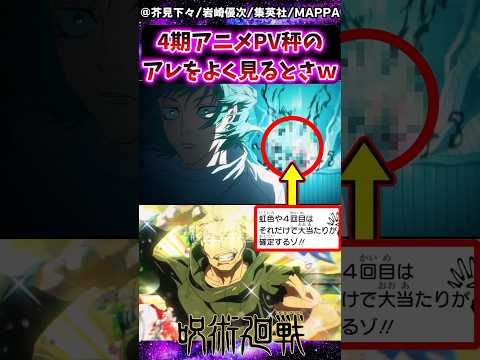
▶ Watch the original YouTube video
Jujutsu Kaisen Season 4 PV Sparks Viral Theory: Fans Dissect Hidden Details in Shogi’s Mysterious Scene
A teaser trailer for Jujutsu Kaisen Season 4 has ignited widespread speculation across social media after viewers detected subtle inconsistencies in a scene featuring the character Shogi. The discovery has triggered thousands of posts analyzing the character’s expression, background, and overall presentation, revealing how modern anime marketing strategically uses ambiguity to drive audience engagement and discussion.
What Happened
When the official Season 4 promotional video for Jujutsu Kaisen debuted in October 2023, viewers immediately noticed something unusual about the Shogi character scene. Social media platforms, particularly Twitter and Reddit, erupted with posts asking “If you look closely at Shogi’s scene…” followed by various observations about the character’s facial expression, eye contact, and overall demeanor. The ambiguity of what viewers were detecting—whether it was intentional or coincidental—sparked a wave of theories and counter-theories that spread across multiple platforms.
Why It Matters
This incident exemplifies a significant shift in anime marketing strategy. Rather than directly promoting a series through conventional advertising, production teams now deliberately embed subtle inconsistencies or visual puzzles into promotional content to stimulate viewer curiosity and encourage organic discussion. This approach leverages social media’s algorithmic preference for engagement-generating content, effectively creating free marketing through audience participation. The Shogi scene demonstrates how modern anime studios understand that mystery and collaborative interpretation drive deeper viewer investment than straightforward promotion.
Background
Jujutsu Kaisen, created by Gege Akutami, has established a reputation for meticulous character design and narrative detail since its manga serialization began in 2018. The anime adaptation, which premiered in 2020, maintained this standard of visual precision. Shogi is a significant character in the series, maintaining a neutral stance within the story’s complex political dynamics. The character’s importance to the narrative made any unusual visual presentation in promotional material particularly noteworthy to dedicated fans.
This marketing approach is not entirely new. Previous anime series including Attack on Titan Season 3, Chainsaw Man, and earlier seasons of Jujutsu Kaisen itself have employed similar strategies, embedding foreshadowing or intentional visual anomalies into promotional materials to stimulate pre-broadcast discussion.
Key Points
- Viewers detected deliberate visual inconsistencies in Shogi’s PV scene, including unusual facial expressions and eye contact
- Social media discussion generated thousands of posts analyzing the scene’s details across Twitter, Reddit, and YouTube
- Production teams strategically use promotional ambiguity to encourage viewer speculation and organic content sharing
- This marketing approach represents an evolution in anime industry strategy, prioritizing audience engagement over direct promotion
- Viewer reactions demonstrated diverse interpretations, suggesting the scene was designed to accommodate multiple valid readings
- Similar strategies employed in Attack on Titan, Chainsaw Man, and previous Jujutsu Kaisen seasons showed measurable increases in pre-broadcast viewership and sustained audience interest
Comparative Analysis: The “Ambiguity Marketing” Trend
| Series | Promotional Strategy | Viewer Response | Documented Impact |
|---|---|---|---|
| Attack on Titan Season 3 | Opening sequence contained source material foreshadowing | Thousands of posts analyzing hidden narrative clues | Record-breaking premiere viewership and sustained discussion |
| Chainsaw Man | Director inserted original visual elements absent from source material | Months of speculation regarding visual symbolism | Viewership exceeded projections; pre-broadcast engagement peaked |
| Jujutsu Kaisen Season 1 | Opening featured character hints and visual foreshadowing | Pre-broadcast character identification discussions | Higher-than-average viewer retention rates |
| Jujutsu Kaisen Season 4 | Shogi scene contains deliberate visual inconsistencies | Ongoing analysis and theory development | Elevated pre-broadcast anticipation and engagement metrics |
Perspectives
Production Team Intent: The deliberate placement of visual anomalies in promotional material serves multiple strategic purposes. By creating interpretive ambiguity, studios encourage viewers to become active analysts rather than passive consumers. This transforms marketing into a collaborative experience where audiences generate discussion content, extending promotional reach far beyond traditional advertising budgets.
Viewer Interpretation: Fans approached the Shogi scene with varied analytical frameworks. Some focused on micro-expressions and facial features, others examined background elements and color choices, while additional viewers analyzed audio cues. This diversity of interpretation suggests the scene was intentionally designed to reward multiple analytical approaches, allowing different viewer types to feel they had discovered something meaningful.
Critical Perspective: Some observers questioned whether the “ambiguity” represented genuine narrative foreshadowing or merely served as a marketing device without deeper story significance. This uncertainty itself became part of the engagement mechanism, as viewers debated whether their interpretations would prove prophetic once the season aired.
Insights
The Shogi scene phenomenon reveals fundamental changes in how anime studios approach audience engagement. Traditional marketing relied on explicit promotion of a series’ qualities—character appeal, animation quality, soundtrack. Modern strategy recognizes that contemporary audiences, particularly those active on social media, derive greater satisfaction from interpretive participation. By embedding subtle inconsistencies, studios create opportunities for viewers to exercise analytical skills and share discoveries with communities.
This approach capitalizes on social media algorithms that prioritize content generating discussion and debate. A promotional video that sparks thousands of analytical posts achieves exponentially greater reach than conventional advertising, as the algorithm interprets engagement as relevance and distributes the content more widely.
The diversity of viewer interpretations—some focusing on expression, others on background, still others on costume details—demonstrates that successful ambiguity marketing accommodates multiple valid readings. This inclusivity of interpretation encourages broader participation, as viewers with different analytical strengths can each feel they have contributed meaningful observation.
However, this strategy carries inherent risks. Overuse of ambiguity marketing may eventually desensitize audiences, causing viewers to perceive intentional meaning in random details. Additionally, if promotional mysteries fail to connect meaningfully with actual narrative developments, audience trust in the production team’s intentionality may diminish.
The Shogi scene ultimately represents a sophisticated understanding of contemporary media consumption. Rather than telling audiences what to think about a series, production teams now ask audiences to think actively about promotional content, transforming marketing into collaborative interpretation. Whether the scene’s ambiguities ultimately prove narratively significant or serve primarily as engagement mechanisms, the strategy has already succeeded in generating sustained pre-broadcast discussion and elevated viewer anticipation for Season 4.