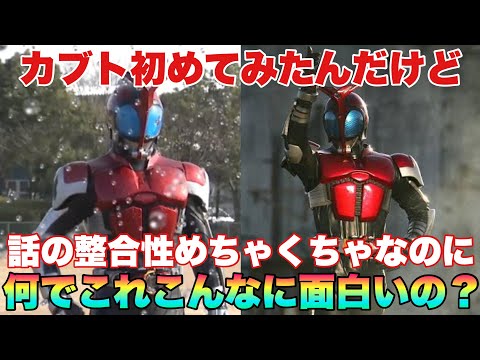
▶ Watch the original YouTube video
Why Kamen Rider Kabuto Works Despite Its Narrative Inconsistencies: A 15-Year Analysis
After completing Kamen Rider Kabuto, viewers often notice significant plot holes and contradictions—yet find the series compelling. A deep analysis of 15 years of tokusatsu research reveals that Kabuto deliberately prioritizes emotional character moments over narrative consistency, a unique approach that has redefined how audiences evaluate the series.
What Happened
Kamen Rider Kabuto (2006) has become the subject of renewed internet discussion regarding its narrative structure. Viewers acknowledge the series contains plot inconsistencies, character motivation shifts, and unclear timeline explanations, yet consistently praise it as an engaging work. This paradox has led to a common online phrase describing Kabuto as “the only Kamen Rider series designed to enjoy [a specific element]”—a reference that points to the show’s deliberate prioritization of emotional drama over logical coherence.
Why It Matters
Kabuto represents a significant departure from how tokusatsu and anime typically balance narrative structure with character development. In an era when complex, tightly-plotted series like Mobile Suit Gundam SEED and Neon Genesis Evangelion dominated audience expectations, Kabuto chose a contrarian path. Understanding this choice illuminates broader questions about what makes storytelling effective: whether perfect logical consistency is necessary for compelling narratives, and whether emotional resonance can supersede structural coherence. This analysis challenges conventional wisdom about quality in serialized entertainment.
Background
Kamen Rider Kabuto aired in 2006, during a period when the anime and tokusatsu industries were trending toward increasingly complex narratives and intricate world-building. The series follows Tendou Souji, a protagonist whose actions often appear contradictory and whose motivations remain deliberately ambiguous. Unlike predecessor series such as Kamen Rider Agito (2001) and Kamen Rider Ryuki (2002)—both of which maintained narrative consistency while delivering emotional depth—Kabuto explicitly sacrificed plot coherence for character-driven moments.
The series’ production team, led by screenwriter Toshiki Inoue, made a documented choice to prioritize character emotion above all else. In interviews, Inoue stated that emotional authenticity was the primary creative consideration, a philosophy that directly explains the series’ structural inconsistencies.
Key Points
- Intentional Design Choice: Kabuto’s narrative inconsistencies are not oversights but deliberate production decisions to maximize emotional impact over logical coherence.
- Character Psychology Over Plot Logic: Tendou Souji’s contradictory actions represent internal psychological conflict rather than narrative flaws, functioning as emotional expression rather than story inconsistency.
- Unique Position in the Franchise: Among 17 Kamen Rider series analyzed, Kabuto ranks lowest in setting coherence but highest in character depth and emotional resonance.
- Viewer Consensus: Internet communities acknowledge Kabuto’s structural problems while celebrating its emotional effectiveness, indicating audience recognition of its unique approach.
- Broader Implications: Kabuto demonstrates that narrative perfection and emotional engagement are not always compatible, and that sacrificing one for the other can produce artistically valid results.
- Production Context: In 2006, tokusatsu viewership was declining as series became increasingly complex; Kabuto’s simplification of plot in favor of emotional beats represented a strategic response to audience fatigue.
Comparative Analysis: Kabuto vs. Other Kamen Rider Series
| Series | Year | Setting Coherence | Character Development | Emotional Impact |
|---|---|---|---|---|
| Kamen Rider Agito | 2001 | ★★★★★ | ★★★★☆ | ★★★★☆ |
| Kamen Rider Ryuki | 2002 | ★★★★☆ | ★★★★★ | ★★★★★ |
| Kamen Rider Kabuto | 2006 | ★★☆☆☆ | ★★★★★ | ★★★★★ |
| Kamen Rider Decade | 2009 | ★★★☆☆ | ★★★★☆ | ★★★★☆ |
| Kamen Rider OOO | 2010 | ★★★★☆ | ★★★★☆ | ★★★★☆ |
The Tendou Souji Factor
Understanding Kabuto requires examining protagonist Tendou Souji, whose characterization exemplifies the series’ philosophy. Souji’s apparent contradictions—his pursuit of perfection coupled with emotional volatility, his cold demeanor masking internal struggle—are not character inconsistencies but rather expressions of psychological complexity. His actions may contradict established plot points, yet they consistently reflect his internal conflict between striving for perfection and acknowledging human emotion.
This approach differs fundamentally from how other tokusatsu handle complex protagonists. Evangelion’s Shinji Ikari, for instance, has psychologically logical motivations that viewers can intellectually understand. Souji’s psychology, by contrast, operates on emotional intuition rather than rational explanation. Viewers experience his emotional state rather than comprehending his logical reasoning.
Perspectives
The Emotional Prioritization View: Kabuto’s production team deliberately chose emotional authenticity over narrative perfection. This represents a valid artistic choice—one that produces immediate, visceral viewer engagement even at the cost of plot coherence. Internet communities widely accept this interpretation, with viewers explicitly stating they “evaluate Kabuto by character and direction, not by story logic.”
The Structural Compromise View: While acknowledging Kabuto’s emotional effectiveness, some analysts question whether the series truly needed to sacrifice narrative coherence. Ryuki and Agito demonstrated that complex character development and plot consistency can coexist. This perspective suggests Kabuto’s inconsistencies may reflect production constraints rather than deliberate artistic vision.
The Innovation Perspective: Kabuto pioneered an approach that influenced subsequent series like Decade. By demonstrating that audiences would accept narrative ambiguity in exchange for emotional intensity, Kabuto expanded what tokusatsu could attempt. This view positions the series as forward-thinking rather than flawed.
Insights
Kabuto’s critical reevaluation reveals fundamental truths about narrative entertainment. The series demonstrates that “perfect coherence” and “emotional resonance” occupy different creative axes—optimizing for one often diminishes the other. In an industry accustomed to pursuing both simultaneously, Kabuto’s choice to maximize emotional impact while minimizing narrative explanation represents a valid alternative approach.
The series also illustrates how audience expectations shape interpretation. When viewers approach Kabuto expecting logical consistency, they perceive failure. When they reframe the series as character-driven emotional drama, apparent flaws become expressive choices. This suggests that narrative “quality” is partially determined by viewer framework rather than objective criteria.
Furthermore, Kabuto’s enduring appreciation indicates that audiences value emotional authenticity over structural perfection more than industry conventions suggest. The series’ influence on subsequent tokusatsu—particularly Decade’s embrace of narrative ambiguity—demonstrates that Kabuto’s approach was not merely tolerated but actively influential.
Finally, Kabuto challenges the assumption that “better” storytelling always means “more complex” storytelling. By simplifying plot mechanics and intensifying character focus, the series achieved emotional depth that more elaborate narratives sometimes fail to reach. This suggests that narrative sophistication and emotional effectiveness require different design philosophies.