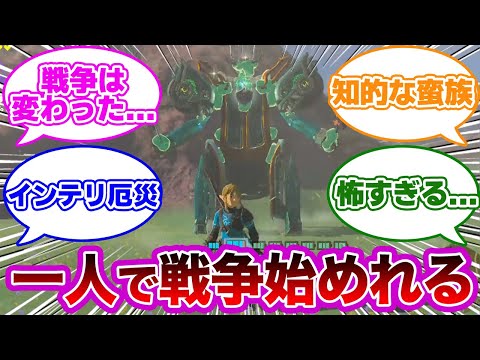
▶ Watch the original YouTube video
Tears of the Kingdom’s Weaponized Zonau Gear: How Player Ingenuity Created a New Calamity
Players of The Legend of Zelda: Tears of the Kingdom have discovered that the game’s Zonau Gear system enables the creation of automated weapons far more powerful than the ancient Guardians of the previous era. This emergent gameplay has fundamentally transformed how players engage with the game’s combat system, raising profound questions about the relationship between player agency, game design, and narrative meaning.
What Happened
Since Tears of the Kingdom’s release in May 2023, players have systematically weaponized the Zonau Gear crafting system to create automated turrets, bombers, tanks, and other military hardware. Using the game’s blueprint system, players can manufacture unlimited copies of these weapons as long as Zonau materials remain available. This discovery has fundamentally altered how the game is played, transforming The Legend of Zelda—traditionally a sword-and-bow adventure—into something resembling a military strategy or shooting game.
The most striking aspect of this phenomenon is that the game’s design appears to accommodate and even encourage this weaponization. Rather than preventing such creations through artificial limitations, the developers built systems that reward player creativity and experimentation, even when those experiments result in game-breaking power levels.
Why It Matters
This development represents a significant moment in game design philosophy. Tears of the Kingdom demonstrates how modern games can grant players extraordinary creative freedom while simultaneously embedding that freedom within a meaningful narrative framework. The weaponization of Zonau Gear is not merely a mechanical exploit—it functions as a form of character development for Link, transforming him from a lone warrior into a military commander.
The phenomenon also raises important questions about game balance, player agency, and the definition of what a game “is.” When players can fundamentally alter a game’s genre and difficulty through legitimate means, it challenges traditional notions of game design and suggests a new paradigm where player interpretation and modification are central to the experience.
Background
Tears of the Kingdom is the sequel to Breath of the Wild (2017), which itself was revolutionary for granting players unprecedented freedom in how they approached puzzles and combat. Where Breath of the Wild introduced the concept of “emergent gameplay” through environmental interaction and tool usage, Tears of the Kingdom extends this philosophy through the Zonau Gear system.
The Zonau Gear system allows players to combine various mechanical components—fans, wheels, weapons, sensors, and power sources—to create functional devices. The blueprint feature enables players to save designs and manufacture them repeatedly, creating an infinite production system limited only by resource availability.
In the game’s narrative, the ancient Sheikah civilization created Guardians—powerful automated weapons that were eventually corrupted by Calamity Ganon. Tears of the Kingdom presents a scenario where players, through Link, gain access to Zonau technology and must decide how to use it. The irony is that player-created weapons often exceed the Guardians in strategic flexibility and production capacity.
Key Points
- Weaponization Scale: Players have created automated turrets, aircraft, tanks, and other military devices that function as effective combat solutions, fundamentally changing how they engage with the game.
- Production Capacity: Unlike the ancient Guardians (limited to four units), player-created weapons can be manufactured infinitely through the blueprint system, provided materials are available.
- Strategic Superiority: Player-created weapons demonstrate greater tactical flexibility and customization potential than the fixed designs of ancient technology, suggesting a reversal of technological dominance.
- Narrative Integration: The weaponization process functions as character development, transforming Link from a individual warrior into a military leader, echoing themes of civilization and power from the broader Zelda narrative.
- Game Design Philosophy: The game’s systems appear intentionally designed to permit and reward player creativity, even when that creativity produces outcomes that exceed traditional game balance expectations.
- Thematic Resonance: The creation of powerful weapons raises questions about the cyclical nature of conflict and whether technological advancement inevitably leads to destruction, mirroring themes from the game’s lore.
Timeline
- May 2023: Tears of the Kingdom releases; players begin experimenting with Zonau Gear combinations.
- Early Post-Launch Period: Players discover that automated weapons can be created and manufactured repeatedly through the blueprint system.
- Community Spread: Weaponization techniques spread across social media platforms (Twitter, Reddit, YouTube), with players sharing increasingly sophisticated designs.
- Ongoing: The weaponization phenomenon continues to evolve, with players discovering new combinations and applications for Zonau Gear.
Perspectives
Player Enthusiasm: Many players express excitement and wonder at the creative possibilities enabled by the Zonau Gear system. Comments like “Zelda turned into a shooting game” reflect both surprise and delight at the emergent gameplay possibilities. Players appreciate the freedom to approach challenges in unexpected ways.
Design Appreciation: Game analysts view the weaponization phenomenon as evidence of masterful game design. Rather than restricting player creativity through artificial limitations, the developers created systems flexible enough to accommodate and reward experimentation, even when it produces unintended outcomes.
Narrative Concern: Some observers note the thematic implications of unlimited weapon production. The infinite blueprint system evokes the automated warfare depicted in works like the anime “86,” raising questions about whether the game is subtly warning players about the dangers of unchecked militarization.
Genre Ambiguity: A minority of players express concern that weaponization transforms Tears of the Kingdom into something other than a Zelda game, questioning whether the core experience is compromised when players opt for overwhelming firepower rather than engaging with the game’s intended puzzle and exploration mechanics.
Insights
Tears of the Kingdom represents a watershed moment in game design where player agency and narrative meaning become inseparable. The weaponization of Zonau Gear is not a bug or an unintended consequence—it appears to be a deliberate design choice that transforms how players understand Link’s character arc.
In Breath of the Wild, Link was a lone warrior fighting against overwhelming odds. In Tears of the Kingdom, players who embrace weaponization transform Link into something fundamentally different: a military commander capable of producing unlimited automated weapons. This transformation mirrors real-world patterns of technological escalation and raises implicit questions about power, responsibility, and the cyclical nature of conflict.
The game’s design philosophy suggests that modern game developers are increasingly comfortable with player-driven reinterpretation of their work. Rather than enforcing a single “correct” way to play, Tears of the Kingdom accommodates multiple playstyles—from traditional sword-and-bow adventuring to full-scale military industrialization. This flexibility may represent the future of open-world game design, where player creativity is not just permitted but celebrated.
The thematic resonance is particularly striking: players who create unlimited weapons are, in a sense, recreating the conditions that led to the original Calamity. The game appears to be asking whether technological advancement inevitably leads to destruction, and whether the cycle of conflict can ever truly be broken. By permitting players to create a “new calamity” through their own choices, Tears of the Kingdom embeds this philosophical question directly into its mechanics.