▶ Watch the original YouTube video
Hunter x Hunter: Fan Reactions to Gon and Killua’s Long-Awaited Return After 12 Years
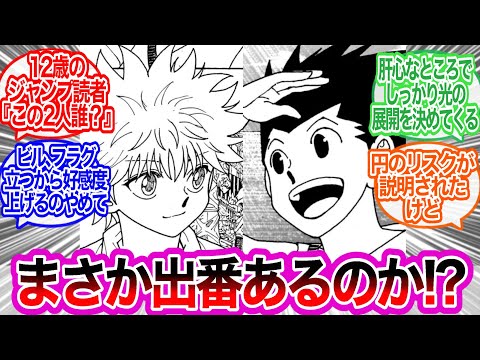
After a 12-year absence from the narrative, protagonists Gon and Killua make a dramatic reappearance in Chapter 414 of Hunter x Hunter, serving as bodyguards for Prince Woble in the Succession War arc. The return has sparked intense fan reactions and signals a significant narrative shift in the series’ complex political storyline.
What Happened
In Chapter 414 of Hunter x Hunter, Gon and Killua return to the narrative for the first time since Chapter 345, appearing as bodyguards for Prince Woble in the Succession War arc aboard the Black Whale. The reappearance comes at a critical moment when Kurapika, facing the complexities of the succession conflict, reaches out to the two characters as trusted allies. This marks a pivotal moment in the series, as the two main protagonists re-enter a storyline that has been dominated by Kurapika and other supporting characters for over a decade of publication.
Why It Matters
The return of Gon and Killua represents more than nostalgic fan service—it signals a fundamental shift in the narrative structure of the Succession War arc. Their reappearance introduces an external perspective to the increasingly complex political machinations occurring within the Black Whale, potentially providing readers with a clearer lens through which to understand the arc’s intricate plot developments. Additionally, the return raises significant questions about how Gon, who lost his Nen abilities in previous arcs, will contribute meaningfully to conflicts involving highly skilled Nen users. This development suggests that creator Yoshihiro Togashi intends to explore themes beyond conventional power scaling, focusing instead on character relationships and personal growth.
Background
Gon and Killua’s last appearance occurred in Chapter 345, following the conclusion of the Election arc. Since then, the narrative has focused on Kurapika’s involvement in the Succession War, a complex political conflict aboard the Black Whale involving multiple royal princes, their respective factions, and various external threats. The Succession War arc has been characterized by its intricate plotting, numerous character perspectives, and morally ambiguous situations. Gon’s permanent loss of Nen abilities at the end of the Chimera Ant arc created narrative questions about how he could remain relevant in high-level conflicts. The 12-year gap between Gon and Killua’s last appearance and their return in Chapter 414 represents one of the longest absences of major protagonists in the series.
Key Points
- Gon and Killua appear in Chapter 414 as bodyguards for Prince Woble, marking their first appearance in 12 years since Chapter 345
- Kurapika requests their assistance as trusted allies, signaling his acknowledgment that he cannot face the Succession War alone
- The reappearance introduces an external perspective to the ship-based conflict, potentially providing narrative clarity to the arc’s complex political dynamics
- Gon’s inability to use Nen raises questions about how he will contribute to conflicts involving advanced Nen users
- Fan speculation suggests the appearance of a female character resembling an “Indian-style girl” may indicate significant character development for Gon
- The return has intensified fan expectations for Leorio’s eventual reappearance and a potential reunion of all four main protagonists
Timeline
- Chapter 345: Gon and Killua’s last appearance before the 12-year narrative gap
- Chimera Ant Arc: Gon loses his Nen abilities permanently
- Election Arc: Killua’s character development and his commitment to protecting Gon
- Succession War Arc begins: Kurapika becomes the central focus as the narrative shifts to political intrigue aboard the Black Whale
- Chapter 414: Gon and Killua’s dramatic return as bodyguards for Prince Woble
Perspectives
The reappearance of Gon and Killua has generated multiple interpretations among the fan community. Some viewers interpret the return primarily as fan service—a long-awaited reunion with beloved characters after years of absence. Others view it as a deliberate narrative choice by Togashi to introduce structural balance to the Succession War arc, which has become increasingly complex with multiple character perspectives and political factions.
From a narrative structure perspective, the introduction of Gon and Killua as external bodyguards creates a clear separation between the internal politics of the Black Whale and an outside perspective. This mirrors narrative techniques used in other complex stories, where dual perspectives help readers navigate intricate plots. The fact that Kurapika—a character defined by his reluctance to burden others with his personal mission—reaches out to Gon and Killua suggests significant character development, indicating his acceptance that he cannot face his challenges alone.
Regarding Gon’s inability to use Nen, interpretations vary. Some fans express concern that Gon cannot meaningfully contribute to high-level conflicts. Others argue that Togashi is deliberately using this limitation to explore Gon’s core strengths beyond supernatural abilities—his determination, instinct, and capacity for genuine human connection. This perspective aligns with thematic patterns in the series where characters often discover their true power through constraints rather than through unlimited ability.
Insights
The return of Gon and Killua appears to represent a deliberate narrative pivot toward exploring themes of human connection and interdependence. Throughout the series, Togashi has demonstrated a consistent pattern of avoiding simplistic resolutions, instead using character limitations as catalysts for deeper exploration of human relationships. Gon’s loss of Nen, rather than being a permanent narrative dead-end, becomes an opportunity to examine what makes him valuable beyond supernatural power.
The Succession War arc, while complex and politically intricate, risks overwhelming readers with its numerous perspectives and factions. The introduction of Gon and Killua as external observers provides a narrative anchor—characters whose primary motivation is personal loyalty rather than political ambition. This shift suggests that Togashi intends to gradually transition the arc from pure political intrigue toward a story about how personal bonds persist and strengthen amid chaos and moral ambiguity.
The potential for a reunion of all four main protagonists—Gon, Killua, Kurapika, and Leorio—looms as a significant narrative milestone. Each character has pursued distinct life goals: Gon sought his father, Killua sought independence, Kurapika pursued revenge, and Leorio pursued his medical career. Their convergence in the Succession War arc may signal a thematic shift from individual ambitions toward collective purpose, suggesting that the series is moving toward its final major arc.
Fan reactions reveal a community simultaneously experiencing joy at the return of beloved characters and uncertainty about narrative justification. This emotional complexity reflects the sophistication of the series itself—Togashi has trained readers to expect both emotional payoff and narrative integrity, making the balance between fan service and plot logic a legitimate concern. The fact that the reappearance includes a plausible narrative justification (bodyguard duty) rather than contrived coincidence suggests Togashi has maintained this balance successfully.