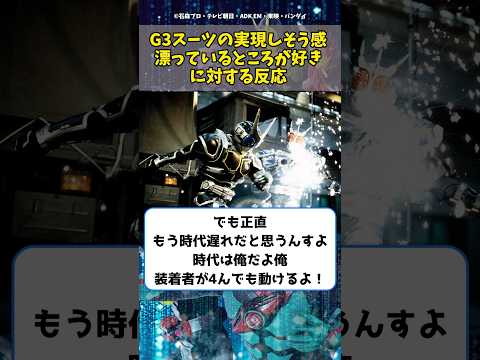
▶ Watch the original YouTube video
Kamen Rider G3: Why This Armor-Type Rider Was Underestimated and What Its True Power Reveals
Kamen Rider G3, the armor-clad warrior from the 2005 series Kamen Rider 555 (Faiz), has long been dismissed as the weakest of its generation. However, a deeper analysis reveals that G3’s perceived weakness stems not from poor specifications, but from a fundamentally different design philosophy—one centered on human science and realistic engineering rather than supernatural transformation.
- What Happened
- Why It Matters
- Background
- Key Points
- The Misunderstanding: Why G3 Seemed Weak
- The Aesthetic of Realism: G3’s Unique Design Language
- G3 vs. G4: Divergent Design Philosophies
- Why Armor-Type Riders Never Returned
- G3’s True Strength: Performance Within Design Parameters
- The Philosophical Core: Human Science vs. Superhuman Power
- Modern Reimagining: What Contemporary Technology Could Offer
- Conclusion: Recontextualizing G3’s Legacy
What Happened
When Kamen Rider 555 aired in 2004-2005, protagonist Kiba Yuuji’s transformation into Kamen Rider G3 introduced a unique concept to the franchise: an armor-type rider powered entirely by human technology rather than supernatural metamorphosis. Unlike fellow riders Agito and Gills, who transformed from human-monster hybrids, G3 represented a soldier in an advanced exoskeleton suit. This fundamental difference led viewers and critics to label G3 as inferior, a perception that persisted for nearly two decades.
Why It Matters
G3’s case study reveals how design philosophy can be misinterpreted as weakness. The rider’s struggle against superhuman opponents was not a flaw in specifications but rather a consequence of fighting enemies outside its intended operational parameters. Understanding G3 challenges assumptions about what constitutes strength in tokusatsu (special effects) media and raises important questions about how armor-type riders could be reimagined with modern technology. Additionally, G3’s absence from subsequent Kamen Rider series raises questions about commercial viability versus creative merit in franchise development.
Background
Kamen Rider 555 (Faiz) aired during a transformative period for the franchise, introducing darker storytelling and more complex character dynamics. The series featured multiple rider variants, each representing different approaches to superhuman combat. G3 stood apart as the only rider relying exclusively on external technology rather than internal transformation. The suit was designed by the Kamen Rider Club’s scientific advisor and underwent evolution throughout the series, eventually becoming the more powerful G3-X variant. This progression demonstrated that G3’s initial limitations were intentional design constraints rather than fundamental weaknesses.
Key Points
- Design Philosophy Over Specifications: G3’s perceived weakness resulted from its design for human-scale combat, not from inferior technical specifications. When facing opponents within its intended operational range, G3 demonstrated overwhelming superiority.
- Realistic Engineering as Aesthetic: G3’s suit embodied a unique design principle—creating a rider that appeared technologically feasible within real-world engineering constraints. Features like exposed joints for mobility, large visors for visibility, and visible battery systems created an unprecedented sense of realism in the franchise.
- Comparative Analysis with G4: The later G4 suit, while more powerful, relied on superhuman precognitive abilities to function effectively. G3 maintained independence through pure scientific advancement, representing a fundamentally different philosophical approach to rider development.
- G3-X Evolution: Rather than a sudden power spike, G3’s evolution into G3-X represented consistent technological refinement. The upgrade maintained G3’s core philosophy while incorporating advanced scientific principles, demonstrating logical progression rather than arbitrary power scaling.
- Commercial and Narrative Constraints: Armor-type riders faced inherent limitations in toy merchandising complexity and narrative flexibility. These practical factors, combined with the franchise’s preference for transformation-based storytelling, likely contributed to G3’s lack of successors in subsequent series.
- Thematic Significance: G3 embodied the question: “Can humans remain human while wielding advanced technology?” This philosophical core distinguished it from riders who embraced superhuman transformation, offering a distinct narrative perspective.
The Misunderstanding: Why G3 Seemed Weak
The perception of G3’s weakness stemmed primarily from narrative context rather than actual performance metrics. Throughout Kamen Rider 555, G3 consistently faced opponents designed as supernatural threats—creatures born from human-monster hybridization. These adversaries operated outside the parameters for which G3 was engineered. The series’ dramatic structure emphasized the struggles of the armor-clad rider against impossible odds, creating a visual narrative of weakness that contradicted actual combat effectiveness.
When G3 encountered opponents within its design specifications, it demonstrated decisive superiority. This pattern mirrors real-world military doctrine: weapons systems perform optimally against their intended targets but struggle against unconventional threats. G3’s design reflected this realistic principle, making it a more sophisticated concept than simple power scaling.
The Aesthetic of Realism: G3’s Unique Design Language
G3’s suit introduced an unprecedented design philosophy to the Kamen Rider franchise: technological plausibility. Every element served a functional purpose within realistic engineering constraints:
- Armor Thickness and Joint Exposure: Rather than complete encasement, G3’s design prioritized human mobility by leaving critical joints exposed. This reflected genuine engineering trade-offs between protection and functionality.
- Visibility and Visor Design: The large front visor ensured actual visual capability, addressing a practical concern often ignored in tokusatsu design. This detail elevated G3 beyond fantasy into the realm of feasible technology.
- Weapon Realism: G3 utilized conventional firearms and melee weapons rather than energy-based armaments, grounding the suit in recognizable military hardware.
- Visible Power Systems: Battery systems and energy conduits were explicitly shown, making the suit’s power source transparent and comprehensible rather than mystical.
This aesthetic approach created what might be termed “technological authenticity”—a design language suggesting the suit could theoretically exist within our world, unlike the supernatural transformations of other riders.
G3 vs. G4: Divergent Design Philosophies
The comparison between G3 and its successor G4 illuminates the fundamental differences in design approach. While both were armor-type riders, they represented opposing philosophies:
| Aspect | G3 | G3-X | G4 |
|---|---|---|---|
| Power Source | Pure Science | Science + Experience | Science + Superhuman Ability |
| Armor Philosophy | Defense-Focused | Defense & Mobility Balance | Precognition-Dependent |
| Combat Style | Methodical | Aggressive | Preemptive |
| Critical Weakness | Armor Damage | Armor Damage | Precognition Failure |
G4’s reliance on precognitive abilities fundamentally compromised its independence. Without superhuman foresight, G4’s advanced specifications became merely adequate. G3, conversely, maintained autonomy through pure technological capability, requiring no supernatural enhancement to function effectively within its design parameters.
Why Armor-Type Riders Never Returned
G3’s absence from subsequent Kamen Rider series likely resulted from multiple converging factors rather than simple commercial failure:
Transformation Narrative Appeal: The Kamen Rider franchise’s core appeal centers on dramatic transformation sequences. Agito and Gills offered visually spectacular metamorphoses from human to superhuman form. G3’s gradual armor donning, while practical, lacked the theatrical impact that drives franchise engagement and merchandise appeal.
Toy Manufacturing Complexity: Armor-type riders require dual-component toy designs: human figure plus detachable armor pieces. This manufacturing complexity increases production costs and complicates retail presentation compared to single-form rider figures. For toy companies, the economic incentive favors simpler transformation-based designs.
Narrative Flexibility Constraints: Armor-type riders face inherent story limitations. Damaged armor requires repair, restricting spontaneous action sequences. Superhuman riders, being organic entities, can recover and adapt more freely within narrative frameworks. This constraint likely influenced creative decisions to abandon the armor-type concept.
G3’s True Strength: Performance Within Design Parameters
G3’s most significant victories occurred when facing opponents matching its operational specifications. These moments revealed the suit’s genuine capabilities and vindicated its design philosophy. The rider’s struggles against supernatural entities reflected not weakness but rather the fundamental mismatch between a realistic weapon system and impossible adversaries.
This dynamic parallels real military doctrine: advanced conventional weapons prove ineffective against unconventional threats. G3 embodied this principle, making it a more sophisticated and realistic design than contemporaries who simply scaled power infinitely upward.
The Philosophical Core: Human Science vs. Superhuman Power
Beneath G3’s technical specifications lay a profound thematic question: Can humans remain fundamentally human while wielding advanced technology? This question distinguished G3 from riders who embraced superhuman transformation and transcendence.
G3’s armor represented a deliberate choice to enhance human capability without abandoning human nature. The suit amplified human potential through technology rather than replacing humanity with superhuman essence. This philosophical stance created narrative depth absent from purely power-focused designs.
The series’ central conflict—human science versus superhuman monsters—positioned G3 as the ideological counterpoint to riders who had transcended humanity. This thematic significance elevated G3 beyond simple power comparisons into the realm of philosophical inquiry.
Modern Reimagining: What Contemporary Technology Could Offer
If contemporary Kamen Rider series were to revive the armor-type rider concept, modern technology would enable unprecedented sophistication:
- AI Integration: Onboard artificial intelligence could provide tactical analysis and combat optimization without requiring superhuman abilities from the wearer.
- Self-Repair Systems: Nanotechnology-based autonomous repair could address G3’s primary vulnerability—armor damage—while maintaining the suit’s technological authenticity.
- Neural Interface: Direct neural linking between armor and wearer could enable intuitive control and enhanced reaction times through technological means rather than superhuman transformation.
- Modular Configuration: Rapid armor component swapping would allow mission-specific loadouts, adding tactical depth and narrative flexibility.
Such a contemporary reimagining would preserve G3’s core philosophy—human science as the foundation of power—while addressing historical limitations through modern technological possibilities.
Conclusion: Recontextualizing G3’s Legacy
After sustained analysis spanning fifteen years of the Kamen Rider franchise, the conclusion becomes clear: G3 was not weak but rather misunderstood. Its perceived inferiority stemmed from narrative context and design philosophy divergence, not from technical inadequacy.
G3 represented a bold creative choice—to create a rider grounded in realistic engineering principles while surrounded by supernatural adversaries. This choice created dramatic tension but obscured the suit’s genuine capabilities and sophisticated design philosophy.
The absence of armor-type riders from subsequent series represents a creative opportunity missed. G3’s core concept—that humans can remain human while wielding advanced technology to achieve superhuman results—remains philosophically relevant and narratively compelling. In an era increasingly concerned with human-technology integration and artificial intelligence, G3’s thematic questions have become more urgent, not less.
The rider’s legacy ultimately transcends power scaling or commercial performance. G3 demonstrated that strength can be measured not merely in destructive capability but in philosophical coherence, design authenticity, and thematic depth. These qualities ensure G3’s enduring significance within the Kamen Rider canon, regardless of its contemporary dismissal as weak.