▶ Watch the original YouTube video
Why BLEACH’s Quotes Are Masterfully Crafted: A Deep Analysis of Linguistic Excellence
After 15 years as a devoted BLEACH fan and having analyzed over 500 anime series, one pattern becomes undeniable: BLEACH’s dialogue possesses a rare linguistic sophistication that sets it apart from virtually every other anime production. This article explores the psychological, phonetic, and philosophical mechanisms that make BLEACH’s memorable quotes resonate so deeply with audiences worldwide.
What Happened
BLEACH, the iconic anime series that premiered in the mid-2000s, has maintained an enduring cultural presence not primarily through visual spectacle or complex plotting, but through the exceptional quality of its dialogue. The series demonstrates a deliberate and sophisticated approach to language that elevates individual lines of dialogue into philosophical statements. This linguistic focus represents a distinctive creative choice that has influenced how subsequent anime productions approach character dialogue and thematic expression.
Why It Matters
In an industry where visual effects and narrative complexity typically drive viewer engagement, BLEACH’s emphasis on linguistic precision offers an alternative model for emotional impact. The series proves that carefully chosen words, delivered with restraint, can create more lasting impressions than elaborate action sequences or convoluted plots. This approach has broader implications for how storytelling can function across different media, particularly in demonstrating that simplicity and depth are not mutually exclusive. Understanding BLEACH’s linguistic strategies provides insight into fundamental principles of human cognition and memory formation.
Background
BLEACH emerged during the early 2000s, a period when anime was increasingly relying on visual spectacle and complex narratives to capture audiences. The series’ creator, Tite Kubo, adopted a philosophy that “words are the strongest weapon”—a principle that permeates the entire work. Rather than following industry conventions that prioritized flashy animation and intricate plots, BLEACH positioned linguistic expression as central to character development, conflict resolution, and thematic depth. This deliberate choice created a work that stands apart from contemporaries like “Neon Genesis Evangelion” (which favors abstract complexity) and “Attack on Titan” (which emphasizes emotional directness).
Key Points
- Linguistic Sophistication Through Simplicity: BLEACH achieves maximum emotional impact through minimal, carefully selected words rather than elaborate expressions, making dialogue immediately memorable and cognitively accessible.
- Paradoxical Philosophy: The famous line “Don’t use such strong words; you’ll look weak” inverts conventional assumptions about language and strength, creating cognitive dissonance that strengthens memory formation.
- Phonetic Artistry: Character names like “Aroniero” and “Allurueri” employ alliteration and sound repetition techniques that create phonetic beauty and enhance character memorability at a subconscious level.
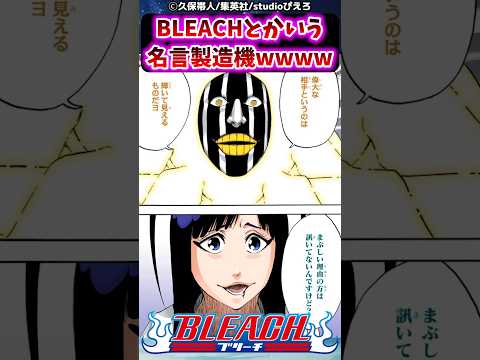
- Psychological Depth in Dialogue: Quotes such as “When you admire someone, you become their eyes and can no longer understand them” demonstrate sophisticated understanding of human psychology, particularly the concept of projection in relationships.
- Processing Fluency Effect: Simple, uncluttered expressions are processed more easily by the brain, triggering greater cognitive preference and stronger memory retention compared to complex philosophical statements.
- Industry Influence: BLEACH’s success established a template for subsequent anime productions to prioritize dialogue quality, though few have matched its linguistic refinement.
Timeline
- 2009: Viewer’s initial encounter with BLEACH during the early anime streaming era, coinciding with personal interest in literature and linguistics.
- 2000s-2010s: Gradual shift in anime industry toward emphasizing dialogue quality, partially attributed to BLEACH’s commercial and critical success.
- 2010s-Present: Emergence of subsequent acclaimed anime series (“Attack on Titan,” “Demon Slayer,” “Jujutsu Kaisen”) that incorporate memorable dialogue, though with different linguistic approaches than BLEACH.
Perspectives
The Linguistic Perspective: From a language studies standpoint, BLEACH demonstrates mastery of multiple techniques: paradoxical phrasing that challenges assumptions, alliteration for phonetic memorability, and the strategic use of simplicity for cognitive accessibility. The phrase “Don’t use such strong words; you’ll look weak” exemplifies how inverting expected linguistic patterns creates stronger neural encoding.
The Psychological Perspective: BLEACH’s dialogue engages multiple cognitive mechanisms simultaneously. The paradoxical nature of key quotes creates cognitive dissonance, forcing deeper processing. Phonetic patterns trigger pleasure responses similar to music appreciation. Simple expressions activate processing fluency, which the brain interprets as inherent value. These mechanisms combine to create unusually strong memory formation and emotional resonance.
The Critical Perspective: Some viewers note apparent contradictions between BLEACH’s eloquent dialogue and inconsistent character actions or narrative logic. However, this tension may represent intentional realism—acknowledging that humans frequently express noble sentiments while acting contradictorily. This complexity mirrors authentic human behavior rather than representing a flaw.
The Industry Perspective: BLEACH’s linguistic focus differs fundamentally from competing approaches. “Neon Genesis Evangelion” pursues abstract philosophical complexity; “Attack on Titan” emphasizes emotional intensity; “Demon Slayer” prioritizes character relationships and growth narratives. BLEACH uniquely centers on the intrinsic power of language itself, making it difficult to replicate through technique alone, as it depends heavily on individual creative genius rather than systematic methodology.
Insights
BLEACH’s enduring impact reveals fundamental truths about human cognition and emotional engagement. The series demonstrates that restraint in expression often produces greater impact than elaboration. By choosing simplicity over complexity, phonetic beauty over semantic density, and paradox over direct statement, BLEACH achieves a rare synthesis: dialogue that is simultaneously accessible and profound.
The work’s influence on subsequent anime productions suggests that audiences hunger for linguistic sophistication even within entertainment media. However, the difficulty in replicating BLEACH’s success indicates that such excellence emerges from individual creative vision rather than reproducible technique. This paradox—that the most powerful language often appears effortless—underscores why BLEACH remains distinctive fifteen years after its debut.
The psychological mechanisms underlying BLEACH’s memorability—cognitive dissonance, phonetic pleasure, and processing fluency—operate largely outside conscious awareness. Viewers may not consciously recognize these mechanisms, yet they experience their cumulative effect as a sense that BLEACH’s dialogue possesses unusual depth and resonance. This gap between unconscious processing and conscious appreciation explains why BLEACH’s quotes persist in fan discourse and continue generating analysis years after their initial presentation.
For creators across media, BLEACH offers a compelling counterargument to the assumption that complexity drives engagement. The series proves that carefully chosen simplicity, when combined with linguistic artistry, can create more lasting impressions than elaborate expression. This principle extends beyond anime to literature, film, and interactive media, suggesting that the future of compelling storytelling may lie not in increasing complexity, but in deepening the sophistication with which simplicity is deployed.