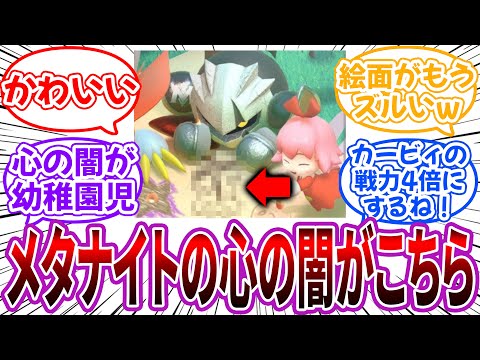
▶ Watch the original YouTube video
Unmasking Dark Meta Knight: The Hidden Darkness Behind Kirby’s Enigmatic Warrior
After 15 years of analyzing the Kirby series, one character stands out as the most paradoxical: Dark Meta Knight. This mysterious entity, which embodies Meta Knight’s suppressed desires and inner conflict, reveals a complex psychological depth rarely seen in Nintendo’s beloved platformer franchise.
What Happened
Dark Meta Knight first appeared in Kirby’s Mirror Maze as a mysterious antagonist capable of splitting Kirby into four separate entities with a single strike. Unlike typical boss characters, Dark Meta Knight immediately retreated after achieving this goal, leaving players with more questions than answers. Later appearances in Kirby Star Allies revealed that this entity could split other characters as well, suggesting a deeper purpose beyond simple combat.
The character’s design and behavior suggest something far more profound than a standard villain: Dark Meta Knight appears to be the physical manifestation of Meta Knight’s repressed inner desires and the psychological conflict between his public persona as a noble knight and his true nature as a warrior obsessed with combat.
Why It Matters
Dark Meta Knight represents a sophisticated approach to character development rarely seen in platformer games. By introducing a character that embodies a protagonist’s shadow self—a concept borrowed from Jungian psychology and popularized in games like Persona 4—the Kirby series elevates its narrative complexity beyond typical Nintendo fare.
Understanding Dark Meta Knight requires examining the gap between Meta Knight’s public role as a disciplined, honorable warrior and his private desires for ultimate combat. This psychological duality resonates with players because it reflects a universal human experience: the tension between societal expectations and personal desires. The character’s existence forces both players and creators to confront uncomfortable truths about Meta Knight’s true motivations.
Background
Meta Knight has been a central figure in the Kirby franchise since his introduction. Initially perceived as a powerful rival, he evolved into a more complex character whose motivations became increasingly ambiguous. The introduction of Dark Meta Knight in Kirby’s Mirror Maze marked a turning point, suggesting that Meta Knight’s stoic exterior masked deeper psychological conflict.
The concept of a character’s “shadow self” gaining physical form is not unique to Kirby. Similar themes appear in Persona 4 (where characters confront their Shadows), Mega Man X series (where Sigma represents an obsession with combat), and Metroid series (where Meta Ridley embodies singular focus). However, Dark Meta Knight’s implementation in the Kirby universe presents a distinctly Nintendo interpretation of this psychological archetype.
Key Points
- Dark Meta Knight’s Identity: A manifestation of Meta Knight’s repressed inner self, embodying his true desire for ultimate combat rather than his public persona as a noble knight.
- The Four-Way Split: Dark Meta Knight’s signature ability to split Kirby into four entities may represent an attempt to create the ultimate battle conditions, suggesting a desire to face opponents at their peak strength.
- Mysterious Retreat: Unlike typical villains, Dark Meta Knight immediately withdraws after achieving his goal, indicating his purpose differs from simple conquest or destruction.
- Expanded Capabilities: Kirby Star Allies revealed Dark Meta Knight can split multiple characters, not just Kirby, suggesting a universal desire to amplify combat strength across all opponents.
- Psychological Duality: Meta Knight maintains a facade of chivalry and discipline while Dark Meta Knight represents his authentic desire for combat and personal expression.
- Narrative Evolution: Dark Meta Knight’s role shifted from mysterious antagonist to clearly defined representation of Meta Knight’s inner conflict across successive games.
Timeline
- 2008: Meta Knight gains prominence in Super Smash Bros. Brawl, sparking discussions about his combat abilities and character depth.
- 2009: Dark Meta Knight debuts in Kirby’s Mirror Maze, introducing the concept of Meta Knight’s shadow self.
- 2014: Kirby Triple Deluxe features Dark Meta Knight as a secret boss, further establishing its role as Meta Knight’s inner darkness.
- 2018: Kirby Star Allies reveals Dark Meta Knight’s expanded abilities, demonstrating it can affect multiple characters beyond Kirby.
Perspectives
The Psychological Interpretation: Dark Meta Knight functions as a Jungian shadow archetype—the repository of Meta Knight’s repressed desires. Meta Knight, bound by his self-imposed code of chivalry, must suppress his true nature as a combat-obsessed warrior. Dark Meta Knight embodies this suppression made manifest, representing what Meta Knight would be without societal and self-imposed constraints.
The Combat Maximization Theory: Some analysts suggest Dark Meta Knight’s four-way split represents an attempt to maximize combat potential. By duplicating Kirby, Dark Meta Knight creates multiple opponents simultaneously, intensifying the battle. This interpretation suggests Dark Meta Knight seeks not victory, but the perfect fight—a battle that fully engages all participants at maximum capacity.
The Character Development Perspective: Dark Meta Knight may represent an incomplete stage of Meta Knight’s character arc. Like the Shadow integration in Persona 4, Meta Knight must eventually confront and reconcile with his darker impulses. This would represent genuine character growth, transforming Meta Knight from a conflicted warrior into a fully integrated individual.
The Fan Community View: Online communities have extensively analyzed Dark Meta Knight, with consensus suggesting the character represents “gap moe”—the appeal of contrasts. Meta Knight’s silent, dignified exterior contrasts sharply with Dark Meta Knight’s apparent desire for drawing and combat, creating psychological depth that resonates with players seeking meaningful character analysis.
Insights
Dark Meta Knight’s existence reveals that the Kirby series operates on a level of psychological sophistication often overlooked in discussions of Nintendo’s output. The character serves multiple functions simultaneously: as a boss encounter, as a narrative device, and as a mirror reflecting Meta Knight’s true nature.
The most significant insight is that Dark Meta Knight is not evil—it is honest. While Meta Knight presents himself as bound by knightly honor and restraint, Dark Meta Knight represents his authentic desire: to engage in combat with worthy opponents. This is not malice; it is passion. The tragedy of Meta Knight’s character lies in his self-imposed suppression of this passion in favor of maintaining an idealized public image.
The character’s immediate retreat after splitting Kirby suggests that Dark Meta Knight’s goal was never conquest but rather the creation of optimal battle conditions. This implies Meta Knight—through his shadow self—seeks not to destroy Kirby but to face him at full strength. It is an inverted form of respect: acknowledging an opponent’s worth by ensuring they face you at their absolute peak.
Future Kirby narratives would benefit from exploring Meta Knight’s reconciliation with his shadow self. Rather than viewing Dark Meta Knight as an enemy to be defeated, the series could present it as an aspect of Meta Knight that must be integrated and accepted. This would align with modern psychological understanding and provide genuine character development for one of Nintendo’s most compelling creations.
The Kirby series, often dismissed as simple children’s entertainment, demonstrates that meaningful psychological complexity can exist within accessible gaming experiences. Dark Meta Knight stands as evidence that Nintendo’s franchises contain depths worthy of serious analytical attention.