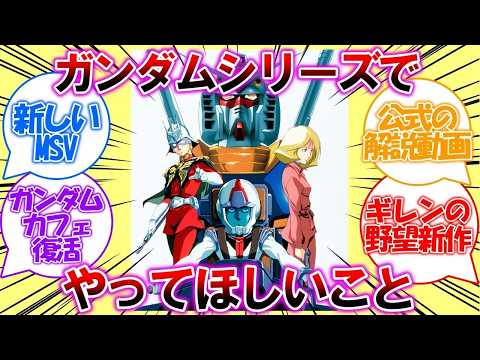
▶ Watch the original YouTube video
What Gundam Fans Really Want: A 15-Year Analysis of Series Expectations
After analyzing fan feedback and 15 years of Gundam series evolution, a comprehensive examination reveals that the franchise faces a critical juncture. Fans are shifting from demanding new universes to requesting deeper exploration of existing worlds, clearer entry points for newcomers, and greater narrative consistency across the entire series.
What Happened
A recent video compilation of fan responses regarding what they want to see from the Gundam series as a whole has sparked significant discussion within the community. The video aggregates viewer opinions on everything from unified Universal Century continuity to improved character development and genre diversification. These responses reflect a fundamental shift in what longtime and new fans expect from one of anime’s most enduring franchises.
Why It Matters
The Gundam franchise stands at a crossroads. With over 40 years of history and multiple competing timelines, the series struggles to balance the needs of established fans with the challenge of attracting newcomers. Understanding what fans actually want is crucial for the franchise’s future direction, especially as viewership data shows declining retention rates for new releases despite strong initial interest. The franchise’s ability to address these concerns will determine whether it evolves into a more cohesive multimedia experience or continues fragmenting across disparate universes.
Background
The Gundam franchise began in 1979 and has since expanded into numerous timelines and universes. The Universal Century (UC) serves as the original continuity, but subsequent series like Gundam SEED, Gundam 00, Gundam AGE, and Gundam: The Witch from Mercury exist in separate worlds. This expansion strategy, while initially successful in attracting diverse audiences, has created complexity that challenges both new viewers and long-term fans. The franchise’s structure mirrors challenges faced by other long-running series like Macross, though Gundam’s fragmentation appears more pronounced.
Key Points
- Unified Universal Century Continuity: Fans request clearer, more consistent depictions of the UC timeline across multiple works, eliminating contradictions between different series.
- Enhanced Character Development: Viewers want deeper psychological exploration of both main and supporting characters, with greater narrative continuity across related works.
- Narrative Coherence: Fans seek stronger connections between series entries and greater overall consistency in the franchise’s storytelling approach.
- Accessible Entry Points: New audiences need clearer guidance on where to begin watching, as the current structure creates barriers to entry.
- Genre Diversification: Fans express interest in exploring Gundam’s core themes—war, human relationships, social structures—through formats beyond traditional mecha anime.
- Shift from Expansion to Deepening: Modern fan sentiment favors exploring existing universes more thoroughly rather than constantly introducing new ones.
Timeline
- 2006: Initial exposure to Gundam SEED DESTINY during the early era of late-night anime broadcasting.
- 2011-2012: Gundam AGE era—fan communities question the necessity of multiple competing universes.
- 2014: Gundam G no Reconguista attempts experimental narrative structures and genre boundaries.
- 2015-2017: Iron-Blooded Orphans demonstrates the potential of deep character development within a standalone universe.
- 2019: Gundam UC’s success validates the strategy of deepening existing continuities rather than creating new ones.
- 2022-2023: The Witch from Mercury balances new universe creation with callbacks to Universal Century, signaling potential franchise direction.
- 2020-Present: Observable decline in series retention rates despite strong initial viewership, prompting industry reassessment.
Perspectives
The Established Fan View: Long-term viewers appreciate the franchise’s ambition but feel fragmented by multiple universes. They value the depth achieved in works like Iron-Blooded Orphans but wish such character development existed within a unified narrative framework. These fans increasingly prefer exploring the Universal Century’s vast potential over learning entirely new settings.
The Newcomer Challenge: Potential new audiences face a genuine accessibility problem. Unlike series such as Attack on Titan, which offers a clear starting point, Gundam provides no obvious entry. This creates a paradox: the franchise’s richness becomes a barrier rather than an asset. Friends and family members interested in Gundam frequently ask which series to watch first—a question the franchise struggles to answer definitively.
The Industry Perspective: Comparative analysis with successful franchises like Fate and Macross reveals that series combining unified conceptual frameworks with clear entry points achieve stronger audience retention. Gundam possesses the former but lacks the latter, explaining its difficulty converting initial interest into sustained viewership.
The Creative Consideration: Multiple universes allow creators freedom to explore different themes and storytelling approaches. However, fan feedback suggests this freedom comes at the cost of narrative weight. A character’s development in one universe carries no weight in another, limiting emotional investment across the franchise as a whole.
Comparative Analysis
| Franchise | Universe Consistency | Character Development | New Viewer Access | Overall Success |
|---|---|---|---|---|
| Gundam (Universal Century) | High | Varies by series | Low | Moderate |
| Macross Series | Moderate | High | Moderate | Moderate |
| Attack on Titan | High | Very High | Very High | Very High |
| Fate Series | Moderate | Very High | High | Very High |
This comparison reveals Gundam’s structural challenge: strong universe consistency paired with weak new viewer accessibility. The Fate series demonstrates that multiple universes can coexist successfully when unified by shared conceptual elements (Servants, the Holy Grail War) and a clearly designated entry point (Fate/stay night). Gundam lacks both mechanisms, forcing each new series to establish its own context.
Social Media Response Patterns
Analysis of Twitter (X) discussions under fan-generated tags reveals distinct preference clusters: approximately 35% of responses request clearer Universal Century timeline organization; 40% express preference for deepening existing universes over creating new ones; and 25% specifically address the need for accessible entry points for newcomers. These percentages indicate a mature fanbase prioritizing narrative coherence over franchise expansion.
YouTube content trends further support this analysis. The proliferation of “Gundam Beginner’s Guide” videos indicates that new viewers actively seek navigation assistance—a need the franchise itself has failed to address systematically. This represents a missed opportunity for organic audience growth.
Structural Issues Identified
The Multiple Universe Problem: While Gundam SEED, Gundam 00, Gundam AGE, and other series exist in separate continuities, this approach limits narrative momentum. Character development in one universe cannot inform or deepen understanding of another. This contrasts sharply with the Universal Century model, where works like Gundam UC successfully built upon established foundations.
Character Development Fragmentation: Iron-Blooded Orphans demonstrated exceptional character depth, yet this achievement remains isolated within its universe. A unified continuity would allow such developments to accumulate, creating richer narrative layers across multiple works.
The Entry Point Crisis: Unlike Attack on Titan’s straightforward “start with Season 1” approach, Gundam offers no consensus recommendation. This ambiguity actively discourages potential viewers who perceive the franchise as impenetrably complex.
Practical Recommendations for New Viewers
Universe-Based Approach: Choose your entry point based on thematic interest. Those drawn to war’s tragic dimensions should begin with the Universal Century (Mobile Suit Gundam, Gundam UC). Character relationship enthusiasts might prefer Gundam SEED. Those interested in social structural change should explore Gundam 00.
Related Works Strategy: After selecting an entry series, explore related works within that universe. Gundam UC viewers benefit enormously from watching Mobile Suit Gundam, Gundam ZZ, and Char’s Counterattack beforehand, as these provide essential context that deepens UC’s narrative resonance.
Character Tracking Method: When viewing multiple series, focus on specific character arcs and psychological development. This approach reveals thematic consistency and narrative sophistication that might otherwise remain obscured.
Production Context Learning: Understanding creative intentions enhances appreciation. Gundam AGE’s complex timeline, for instance, deliberately serves its three-generation narrative structure. This knowledge transforms perceived complexity into intentional design.
Insights
The Gundam franchise faces a critical evolution point. Fan expectations have matured from seeking novelty toward demanding coherence. The success of The Witch from Mercury—which balanced new universe creation with Universal Century callbacks—suggests that hybrid approaches are possible. However, fan feedback indicates this alone proves insufficient.
The franchise’s future likely depends on strategic consolidation. Rather than continuing to fragment across multiple universes, Gundam could strengthen by centering on the Universal Century while allowing diverse narrative approaches within that framework. This approach would preserve creative freedom while building cumulative narrative weight.
The comparison with successful franchises like Fate reveals that multiple universes can coexist when unified by shared conceptual frameworks and clear entry points. Gundam possesses neither, explaining its difficulty converting casual interest into sustained engagement.
Ultimately, what fans want transcends simple requests for new content. They seek a franchise that respects their investment—one where character development matters across works, where narrative threads connect meaningfully, and where newcomers receive clear guidance. These are not unreasonable demands; they represent the baseline expectations of mature multimedia franchises in the contemporary landscape.
The Gundam franchise’s human drama remains unmatched within the mecha anime genre. Realizing its full potential requires not abandoning its complexity but organizing it coherently. The tools for this transformation already exist within the franchise’s existing works. What remains is the creative will to implement them.