▶ Watch the original YouTube video
Why Kamen Rider Saber’s Final Boss Striuus Is Perfectly Imperfect: A Deep Analysis of Tokusatsu’s Most Unconventional Villain
Kamen Rider Saber’s final antagonist Striuus defies traditional tokusatsu villain archetypes by embodying creative despair rather than world domination. After 15 years of analyzing anime and tokusatsu, this character represents a fundamental redefinition of what a final boss can be—not through strength, but through existential anguish that resonates with creators and audiences alike.
What Happened
Kamen Rider Saber, which premiered in 2020, introduced a final antagonist named Striuus whose character design and motivations fundamentally diverge from conventional tokusatsu villains. Rather than seeking world domination or personal power, Striuus struggles against the predetermined nature of existence itself—specifically, a mystical tome called the “Omniscient Book” that has already written all events, including his own actions. His response is not to conquer the world, but to perform the role of a final boss in an attempt to impose meaning on an incomplete narrative.
Why It Matters
Striuus represents a paradigm shift in how tokusatsu and anime conceptualize antagonists. Rather than embodying external threats, he embodies internal creative despair—a condition that resonates particularly with creators and audiences familiar with existential questions about originality and authorship. His character challenges viewers to reconsider what makes a villain compelling: not their power, but their humanity and the philosophical weight of their struggle. This approach has influenced how contemporary tokusatsu frames its narrative conflicts.
Background
Kamen Rider Saber was developed with “books” as its central motif, positioning literature and storytelling as thematic cornerstones. The series itself faced production challenges, including what could be characterized as an incomplete conclusion rather than a traditional cancellation. This behind-the-scenes reality directly informed Striuus’s character arc: a being who recognizes that his world’s narrative is unfinished and attempts to impose a conclusive ending through his own agency. The Omniscient Book represents the predetermined nature of the series itself—a narrative already written but never fully completed.
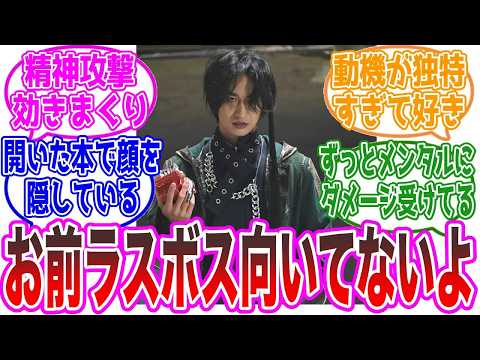
Striuus’s design—with his face obscured by an open book—serves as visual metaphor for his psychological state. He cannot escape the very thing that defines him; he is simultaneously creator and created, author and character within an incomplete story.
Key Points
- Unconventional Motivation: Unlike traditional final bosses, Striuus doesn’t seek to destroy the world or achieve personal dominion. Instead, he struggles against predetermined fate and attempts to author a meaningful conclusion to an incomplete narrative.
- Creative Despair: His core conflict stems from realizing that all his creative works were already recorded in the Omniscient Book, negating his sense of originality and authorship—a uniquely creator-centric form of existential despair.
- Design as Psychology: The book covering his face symbolizes his inability to escape the very source of his anguish; he is trapped by the narrative he simultaneously tries to control.
- Performative Villainy: Striuus essentially “performs” the role of final boss despite lacking genuine villainous intent, representing a final act of creative resistance against predetermined outcomes.
- Psychological Fragility: Despite possessing immense power, Striuus is mentally and emotionally the most vulnerable final boss in tokusatsu history, creating a profound contradiction that defines his character.
- Meta-Narrative Resistance: His actions reflect the production team’s attempt to impose narrative closure on an incomplete series, making him a character-level manifestation of creative struggle against cancellation.
The Nature of Striuus’s Despair
Striuus’s existential crisis differs fundamentally from other tokusatsu antagonists. Characters like Demon King Muzan from Demon Slayer seek immortality and dominion; Kamen Rider villains typically pursue power or revenge. Striuus, however, confronts a uniquely creative form of despair: the negation of originality itself.
The Omniscient Book represents a creator’s worst nightmare—the revelation that nothing one creates is truly original, that all creative output was predetermined. In an era when Striuus’s generation valued absolute originality, this realization constitutes total existential negation. He is told his work is derivative not by critics, but by the fundamental structure of reality itself.
This psychological condition parallels the experience of creators facing the accusation of plagiarism or unoriginality—but amplified to cosmic proportions. Where a contemporary creator might argue that reinterpreting existing concepts with personal perspective constitutes originality, Striuus’s era apparently demanded absolute novelty. The Omniscient Book’s existence retroactively invalidates his entire creative life.
Design Symbolism and Psychological Representation
Striuus’s visual design—an open book obscuring his face—functions as sophisticated psychological symbolism. The book he cannot remove represents the inescapable nature of predetermined narrative. He wishes to look away from the Omniscient Book, to escape its determinism, yet the book is literally affixed to his face. He cannot hide from it; he cannot deny it; he cannot escape it.
This design choice transforms a simple aesthetic into a statement about creative imprisonment. Striuus is simultaneously the reader trying to escape the text and the character trapped within it. His inability to show his true face—his authentic self—beneath the book suggests that his identity has been completely subsumed by the narrative that defines him.
Striuus as Performative Antagonist
One of Striuus’s most distinctive characteristics is that he is not naturally suited to the role of final boss. He performs villainy rather than embodying it. This performative quality represents his final creative act: if he cannot create original works, he will at least create an original ending to his predetermined story.
In this interpretation, Striuus’s assault on the Omniscient Book’s author is not an act of villainy but an act of creative resistance. He is attempting to rewrite the ending, to impose his own narrative closure on a story that was never meant to be completed. The irony—that this act of resistance is itself predetermined—creates a recursive loop of despair that defines his character.
This performative quality distinguishes Striuus from predecessors like Full Frontal from Mobile Suit Gundam UC or Shinji Matou from Fate/stay night, who grapple with existential questions but maintain more conventional antagonistic frameworks. Striuus transcends the antagonist role entirely, becoming instead a character who is simultaneously author, character, and audience of his own narrative.
The Incomplete Narrative and Creative Resistance
Kamen Rider Saber’s production history directly informs Striuus’s character. The series faced an incomplete conclusion—not a traditional cancellation with clear closure, but rather an abrupt narrative interruption. This behind-the-scenes reality manifests within the story itself through Striuus’s recognition that his world’s narrative is unfinished.
The Omniscient Book may not contain a complete ending. It records the broad strokes of fate but leaves individual choices undetermined. This interpretation suggests that Striuus’s struggle occurs within a space of genuine freedom—the freedom to choose within predetermined parameters. His decision to perform as final boss becomes an exercise of that freedom, a personal choice within a predetermined framework.
This framework mirrors the human condition: we are born, we age, we die (predetermined parameters), yet our choices within that framework are genuinely our own. Striuus recognizes this paradox and chooses to exercise his freedom by authoring a conclusion to his incomplete narrative.
Comparative Analysis with Other Antagonists
Striuus’s character becomes more comprehensible when compared to other complex antagonists across anime and tokusatsu. Unlike Demon King Muzan, who seeks concrete immortality, or Eren Yeager, who pursues freedom, Striuus seeks validation of his creative agency. Unlike Madoka Kaname, who finds hope despite temporal loops, Striuus finds only despair in predetermined existence.
The closest parallel may be Shinji Ikari from Neon Genesis Evangelion, who confronts existential despair and the question of whether his choices matter. However, where Shinji is paralyzed by his despair, Striuus actively resists it through performative villainy. This distinction makes Striuus simultaneously more tragic and more compelling as a character study.
Audience Reception and Interpretation
Online communities have responded to Striuus with surprising enthusiasm, despite—or perhaps because of—his unsuitability as a traditional final boss. Social media commentary frequently notes the contradiction between his immense power and his psychological fragility. Phrases like “the final boss who is constantly taking mental damage” appear repeatedly in fan discussions.
This reception suggests that audiences recognize and value the character’s authenticity. Striuus’s despair resonates because it reflects genuine creative anxieties: the fear of originality negation, the terror of being derivative, the existential weight of creative responsibility. For creators and creative professionals, his struggle becomes immediately comprehensible and deeply moving.
Critical commentary emphasizes that Striuus’s unsuitability for the final boss role is precisely what makes him exceptional. His failure to embody traditional villainy becomes his greatest strength, transforming him from antagonist into philosophical inquiry.
Insights
Striuus represents a fundamental evolution in how tokusatsu and anime can conceptualize antagonists. Rather than embodying external threats that heroes must overcome through strength, he embodies internal philosophical crises that audiences must understand through empathy. His character suggests that the most compelling villains are not those with the greatest power, but those whose struggles most authentically reflect human anxieties.
The character also reflects broader creative industry concerns about originality, authorship, and the anxiety of influence. In an era of remakes, adaptations, and intertextual storytelling, Striuus’s despair at discovering his work was predetermined becomes increasingly relevant. He embodies the contemporary creator’s fear: that in a world saturated with existing narratives, genuine originality may be impossible.
Furthermore, Striuus’s character serves as meta-commentary on Kamen Rider Saber’s own production challenges. By making the final antagonist a being who struggles against incomplete narrative, the production team transformed a behind-the-scenes limitation into thematic resonance. The incomplete series becomes not a failure, but a deliberate artistic choice that deepens the narrative’s philosophical inquiry.
Ultimately, Striuus demonstrates that a final boss need not be powerful, threatening, or even genuinely villainous to be compelling. Instead, authenticity of struggle, philosophical depth, and psychological complexity can create a character whose impact transcends traditional antagonistic frameworks. He is not suited to be a final boss precisely because he is too human, too fragile, too genuinely desperate. And that unsuitability is what makes him unforgettable.