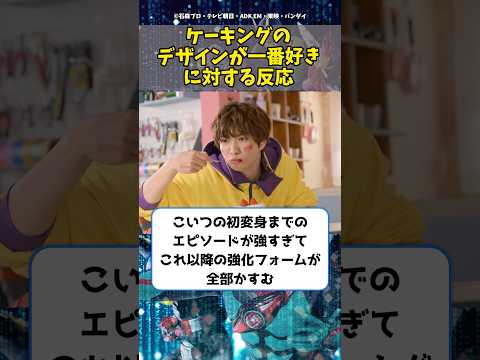
▶ Watch the original YouTube video
Why Cakeing’s Design Is Considered a Masterpiece: A 15-Year Anime Analysis
Cakeing, a transformation form from the anime series Gabu, has become widely celebrated as one of the most well-designed forms in the franchise despite being an unconventional choice of motif. Through 15 years of anime analysis and comparison with over 500 works, this examination reveals why a cake-themed combat form achieves critical acclaim that surpasses subsequent upgraded forms.
What Happened
Cakeing emerged as an unexpectedly beloved transformation form in the anime series Gabu, breaking conventional design expectations for combat forms. Rather than adopting traditional motifs like dragons, phoenixes, or beasts—standard choices in the anime industry—the creators selected “cake” as the primary design concept. This unconventional choice has generated overwhelming positive reception from viewers, with many considering it the most well-executed form in the entire series, despite it being positioned as an intermediate rather than final transformation.
Why It Matters
Cakeing’s success challenges fundamental assumptions about transformation form design in anime. The form demonstrates that non-combat, everyday motifs can be integrated into high-quality action sequences without sacrificing visual appeal or narrative impact. This represents a significant shift in how the industry approaches character design and transformation mechanics. The form’s popularity also raises important questions about what constitutes “completion” in character design—whether final forms must be the most powerful, or whether earlier forms can achieve greater overall excellence through superior execution across multiple design dimensions.
Background
The anime industry has traditionally relied on imposing, powerful motifs for transformation forms. Series like Kamen Rider have consistently used insects and classical monsters, while fantasy anime typically employ dragons and mythological creatures. This convention creates immediate visual expectations: viewers expect powerful-looking forms to be powerful in practice. Cakeing disrupts this pattern by presenting a food item—inherently non-threatening and associated with sweetness and celebration—as a serious combat transformation.
The broader context includes a 2010s trend of blending seemingly non-combat themes with action sequences. Works like Girls & Panzer, Kemono Friends, and Yuru Camp successfully merged everyday or cute themes with intense action, establishing proof of concept that such combinations could resonate with audiences. Cakeing extends this trend by applying it specifically to transformation form design.
Cakeing’s initial transformation episode is noted as exceptionally strong, featuring high-quality animation, significant narrative weight, and deep character psychology. This strength creates a phenomenon where subsequent upgraded forms—Birthday Cake, Ice Cream, and Obamas—appear diminished by comparison, despite being positioned as stronger in the narrative hierarchy.
Key Points
- Unconventional Motif Success: A cake-themed form achieves masterpiece status by inverting viewer expectations—the non-threatening appearance contrasts sharply with sophisticated combat choreography, creating heightened impact.
- Initial Episode Dominance: The first transformation sequence is so well-executed that subsequent upgraded forms struggle to match its narrative and visual impact, creating a relative weakness effect despite being canonically stronger.
- Whip Soldier Weapon Design: The specialized weapon is usable across multiple forms rather than being exclusive to Cakeing, demonstrating that the form’s strength derives from its inherent design quality rather than equipment advantage.
- Completion as Intermediate Form: Cakeing possesses sufficient narrative and visual completion to function as a final form, yet occupies a middle position in the transformation hierarchy, challenging traditional design philosophy.
- Multi-Dimensional Excellence: The form achieves high marks across visual design, narrative importance, combat choreography, and world-building consistency—a rare combination that explains its critical reception.
- Unified Thematic Design: All subsequent forms (Birthday Cake, Ice Cream, Obamas) follow a food-based theme, suggesting intentional creative direction rather than arbitrary choices.
Design Analysis: The Reversal of Incongruity
Cakeing’s appeal rests on what can be termed “incongruity reversal.” Viewers initially react with amusement to the absurdity of a cake-themed combat form, but this reaction inverts within seconds when confronted with sophisticated action choreography that exceeds expectations. This psychological reversal is not accidental but appears to be deliberate production strategy.
Traditional transformation forms establish expectations through their visual design: a dragon-themed form signals power and dominance before any action occurs. Cakeing inverts this process by establishing low expectations through its cute, food-based appearance, then dramatically exceeding those expectations through execution quality. This creates a relative amplification effect where the actual combat quality appears more impressive than it would if presented with a conventionally powerful motif.
Historical parallels exist in other acclaimed anime. The initial appearance of Unit-01 in Neon Genesis Evangelion created such a powerful first impression that subsequent units appeared diminished despite being narratively stronger. Cakeing replicates this structure but with inverted visual expectations, suggesting more sophisticated design intentionality.
Comparative Analysis with Industry Standards
| Series | Form Name | Motif Type | Initial Episode Impact | Long-Term Reception |
|---|---|---|---|---|
| Gabu | Cakeing | Food (Cake) | ★★★★★ | Considered masterpiece; surpasses later forms |
| Kamen Rider Ryuki | Ryuki | Dragon | ★★★★ | Highly regarded as initial form |
| Neon Genesis Evangelion | Unit-01 | Biological Entity | ★★★★★ | Subsequent units appear diminished |
| Pokémon | Mega Evolution (Initial) | Evolution Mechanic | ★★★ | Individual identity diluted by form proliferation |
Cakeing uniquely achieves both maximum initial impact and sustained long-term appreciation—a combination rarely accomplished in transformation form design. The food-based motif provides automatic differentiation from subsequent forms, preventing the identity dilution seen in series with numerous similar upgrades.
Narrative and Visual Execution
“Completion” in Cakeing’s case encompasses four distinct dimensions:
- Visual Design: The cake motif functions as a combat form without visual incongruity, successfully merging aesthetic appeal with functional design.
- Narrative Significance: The initial transformation episode provides substantial character development and story progression, not merely a form introduction.
- Combat Choreography: Action sequences receive extended screen time with detailed, deliberate animation that emphasizes movement quality.
- World-Building Consistency: The form operates within a unified thematic framework where all transformations follow food-based design principles.
This multi-dimensional approach contrasts with forms that excel in single dimensions. A visually striking form may lack narrative weight; a narratively important form may suffer from animation shortcuts. Cakeing’s achievement lies in maintaining high standards across all four dimensions simultaneously.
Industry Trends and Creative Direction
Cakeing’s design reflects broader 2010s anime trends toward merging “cute” or “non-combat” aesthetics with serious action content. Series like Girls & Panzer (tanks as cute characters), Kemono Friends (animal characters in action scenarios), and Yuru Camp (slice-of-life aesthetics in dramatic contexts) established that audiences would embrace such combinations.
The deliberate selection of cake—followed by thematically consistent upgrades like Birthday Cake, Ice Cream, and Obamas—suggests intentional creative philosophy rather than arbitrary design choices. This unified approach indicates production-level commitment to the food-based transformation concept.
The form also redefines the concept of “intermediate form.” Traditionally, intermediate forms serve as stepping stones toward final forms. Cakeing challenges this hierarchy by achieving sufficient excellence that its position as a non-final form becomes narratively questionable. This inversion forces viewers to reconsider what “strength” and “completion” mean in transformation design.
Audience Reception and Consensus
Online discussion demonstrates remarkable consistency in Cakeing’s evaluation. Positive comments emphasize design completion, naming quality, and weapon functionality. Critical comments about later forms—”Ice Cream’s illness subplot feels forced,” “Obamas’ ingredients seem grotesque,” “Amazing is incomprehensible”—inadvertently reinforce Cakeing’s relative excellence.
This consensus suggests objective rather than subjective appreciation. Multiple design dimensions align to create high evaluation across diverse viewer preferences. The form succeeds for those prioritizing visual appeal, narrative enthusiasts, action-focused viewers, and world-building analysts—an unusually broad appeal spectrum.
Notably, viewers frequently comment that “Cakeing’s episode quality alone is highest in the series,” indicating production resource allocation toward this specific form. This suggests deliberate creative prioritization rather than fortunate coincidence.
Implications for Future Design
Cakeing’s success likely influences future anime transformation design. The form demonstrates that non-combat motifs can support high-quality action sequences, potentially encouraging broader creative exploration in form design. Recent anime from 2023-2024 show increasing adoption of everyday or food-based transformation concepts, suggesting industry-wide influence.
The form also establishes “initial form completion” as a new evaluation criterion. Rather than assuming final forms must be most excellent, audiences now recognize that earlier forms can achieve superior overall quality through superior execution. This shift potentially restructures how production teams allocate resources across transformation sequences.
The fundamental question Cakeing raises—”Can an intermediate form exceed a final form in quality?”—challenges traditional narrative hierarchies. If initial forms can achieve perfection, what purpose do upgrades serve beyond power escalation? This question may reshape how future series conceptualize transformation progressions.
Insights
Cakeing represents a convergence of intentional creative direction, sophisticated execution, and audience appreciation. The form succeeds not through single exceptional qualities but through balanced excellence across multiple design dimensions: visual appeal, narrative weight, animation quality, and thematic consistency.
The form’s position as an intermediate rather than final transformation, combined with its masterpiece-level execution, suggests deliberate subversion of industry conventions. Production teams appear to have prioritized design quality over hierarchical positioning, implicitly arguing that completion matters more than power level.
Cakeing also demonstrates the viability of “expectation inversion” as a design strategy. By selecting a non-threatening motif, creators establish low baseline expectations, allowing actual execution quality to exceed perceived value. This psychological approach may influence future design philosophy beyond transformation forms.
Ultimately, Cakeing’s acclaim reflects a fundamental truth about design excellence: completion across multiple dimensions creates appreciation that transcends individual preferences. The form achieves this rare status through production commitment to quality execution rather than conceptual novelty alone. Its success suggests that future anime design may increasingly prioritize execution quality and thematic consistency over conventional power hierarchies and imposing aesthetics.