▶ Watch the original YouTube video
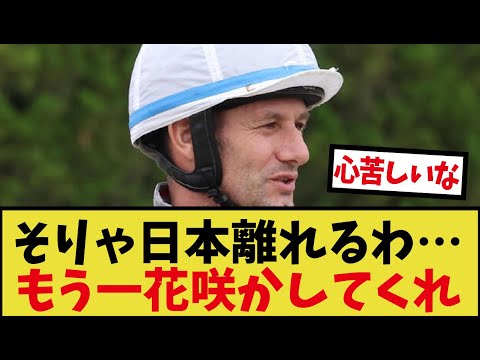
Italian jockey Mirco Demuro, once a dominant force in Japanese horse racing, made the difficult decision to relocate to America after years of declining opportunities and results. His move reveals systemic challenges in Japan’s racing industry and raises important questions about how veteran athletes navigate career transitions in their 40s.
What Happened
Mirco Demuro, an Italian jockey who spent over a decade establishing himself as a top rider in Japan, relocated to the United States to revive his racing career. After experiencing a prolonged slump—six years without significant results—Demuro found himself caught in what observers describe as a “negative spiral”: poor win rates led to fewer riding opportunities, which in turn made it impossible to improve his statistics. Rather than accept diminishing prospects in Japan, the veteran jockey chose to seek a fresh start in America, where he has since found renewed success.
Why It Matters
Demuro’s case illuminates structural problems within Japan’s horse racing industry and broader questions about how professional systems treat aging veterans. His experience demonstrates how individual talent can be constrained by institutional frameworks that prioritize recent performance metrics over experience and potential. Additionally, his decision to relocate at an age when most athletes consider retirement offers a compelling narrative about resilience, adaptation, and the courage required to reset one’s career in unfamiliar territory.
Background
Demuro arrived in Japanese racing as a rising star in the late 2000s, quickly establishing himself as an elite jockey capable of winning major G1 races. For years, he was considered among the finest riders in Japan. However, injuries and subsequent loss of momentum created a cascade of problems. As his win rate declined, horse owners and trainers offered him fewer opportunities to ride quality horses. Without access to competitive mounts, his statistics could not improve, perpetuating the cycle. After nearly a decade of struggling with this system, Demuro explored alternative career paths, including becoming a trainer, but language barriers—specifically his inability to read and write Japanese kanji—closed that door. With limited options remaining in Japan, he made the decision to relocate to America.
Key Points
- The Negative Spiral: Demuro became trapped in a self-reinforcing cycle where poor results led to fewer riding opportunities, making it impossible to improve his win rate.
- Structural System Issues: Japan’s racing industry lacks mechanisms to support veteran jockeys experiencing temporary setbacks, unlike systems that provide external patronage or alternative pathways.
- Language and Career Barriers: Demuro’s inability to read and write Japanese kanji prevented him from pursuing a trainer’s license, eliminating a natural career transition option.
- American Success: In the United States, Demuro has regained competitive form, suggesting that different racing systems and evaluation criteria better suited his abilities.
- Fan Sentiment: Racing enthusiasts expressed mixed emotions—supporting his decision while simultaneously mourning the loss of his presence in Japanese racing.
- Age and Resilience: At over 40 years old, Demuro demonstrated remarkable courage in relocating to a new country and rebuilding his career rather than accepting decline.
The Negative Spiral: How Systems Trap Talented Individuals
Demuro’s own testimony reveals the psychological and professional toll of his situation. He described entering the stable and being greeted with looks that conveyed: “You’re a veteran now with poor results, so we can’t use you.” This is not merely emotional commentary—it points to a fundamental structural problem in Japanese racing.
The logic is circular and inescapable: jockeys with poor win rates receive fewer riding opportunities, yet without quality horses to ride, win rates cannot improve. This creates a trap from which individual effort alone cannot escape. Demuro endured six years of this situation, during which he presumably worked with full dedication while watching his career opportunities diminish.
Interestingly, racing fans noted that other veteran jockeys, such as Takeyoshi, escaped similar predicaments through strong patronage from powerful horse owners. This suggests that breaking the negative spiral requires external support—a resource Demuro lacked. By contrast, foreign jockey Christophe Lemaire achieved sustained success in Japan, partly because his riding style was characterized as “careful” and “trustworthy,” earning confidence from owners and trainers. Demuro’s riding style, described by some as “rough,” may have contributed to his difficulty in securing quality mounts.
Language, Culture, and Closed Doors
A particularly striking detail emerged regarding Demuro’s inability to pursue a trainer’s license: despite living in Japan for nearly a decade, he could not read or write kanji. This limitation became a barrier to career transition, as trainers must manage complex communications with horse owners, breeding facilities, and industry partners.
Racing fans debated this issue extensively. Some argued that without Japanese language proficiency, a trainer cannot effectively manage the responsibilities of the role. Others suggested that modern solutions—such as interpreters or translated materials—could accommodate non-Japanese speakers, pointing to precedents in other professions where language accommodations exist.
Regardless of the merits of either position, the practical outcome was clear: the trainer pathway closed for Demuro. With his jockey career deteriorating and alternative career paths blocked, relocation became a rational choice rather than a desperate escape.
American Racing: A Different System, A Fresh Start
The American racing environment differs significantly from Japan’s system. While some observers attributed Demuro’s improved performance to technical factors—such as the presence of gate attendants reducing false starts—the deeper difference lies in how the industry evaluates and utilizes jockeys.
American racing appears to emphasize direct results and individual performance more transparently. Rather than the cumulative judgment that affects opportunity allocation in Japan, American racing may offer more immediate assessment based on recent performance with quality horses. Demuro’s success in America—described by fans as “doing extremely well”—suggests that the system better suited his abilities and riding style.
This is not to say Demuro’s abilities changed; rather, the environment allowed him to demonstrate capabilities that the Japanese system had constrained.
Fan Perspectives: Support Mixed With Nostalgia
The comment sections reveal complex and sometimes contradictory fan emotions. Many expressed genuine support for Demuro’s decision: “It’s wonderful that he changed his environment and is now achieving results.” Fans recognized that his relocation was not a failure but a pragmatic response to an untenable situation.
Simultaneously, fans expressed melancholy: “I wish I could see Demuro competing at the highest level in Japan again” and “It’s lonely not being able to watch him here.” This sentiment reflects not merely personal preference but an implicit critique of the Japanese racing system that forced his departure.
One particularly insightful comment captured this duality: “Because young Demuro was so extraordinary, we can’t help but expect that level from him now.” Fans who witnessed his peak performance carry the weight of that memory, making his subsequent struggles more poignant.
Another comment expressed a hopeful aspiration: “Find the strongest horse in America and come back to win the Japan Cup.” This reflects fans’ desire to see Demuro prove himself in both systems—to demonstrate that his American success validates his abilities and perhaps inspire his eventual return to Japan.
Insights: Environment, Resilience, and Systemic Questions
Demuro’s case illustrates the profound impact of environmental fit on professional outcomes. Talent and effort are necessary but insufficient; the system within which they operate must provide pathways for their expression. Japan’s racing industry, despite its prestige and competitiveness, created conditions where a proven elite jockey could not access opportunities to demonstrate his abilities.
The decision to relocate at over 40 years old carries particular significance. Most professionals in this age bracket accept decline as inevitable. Demuro instead chose to reset his career in unfamiliar territory—a choice requiring both courage and resilience. His subsequent success in America validates this decision and suggests that age alone does not determine professional viability; rather, environmental alignment does.
For the Japanese racing industry, Demuro’s departure raises uncomfortable questions: Does the system of allocating riding opportunities based on recent win rates serve the sport’s long-term interests? Are there mechanisms to support experienced jockeys through temporary setbacks? Could the industry benefit from greater flexibility in how it evaluates and utilizes veteran talent?
Finally, Demuro’s experience demonstrates that professional reinvention remains possible even in the later stages of a career. His American success offers hope to others facing similar constraints in their own fields, suggesting that sometimes the solution to systemic problems is not to fight the system but to find a better one.