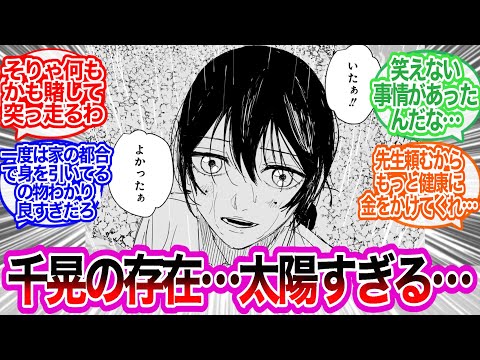
▶ Watch the original YouTube video
Kagurabachi’s Kunio Backstory Arc Breaks Hearts: Fan Reactions and Deep Analysis
The recent Kagurabachi chapter revealing protagonist Kunio’s tragic past has sparked widespread emotional responses across social media. The arc explores how a child raised in violence and loss found redemption through love, raising profound questions about human resilience and sacrifice.
What Happened
Kagurabachi’s latest chapter (126) unveiled the tragic childhood of protagonist Kunio, revealing a deeply disturbing family environment. Kunio grew up with a violent father and a mother broken by abuse. Despite this harrowing upbringing, the narrative shows how Kunio managed to develop into a stable, functional adult—a transformation attributed to a single transformative relationship with a girl named Chiaki when he was twelve years old.
The arc depicts Kunio’s formative years from ages 9 to 12, a period compressed with multiple traumas: paternal violence, maternal loss, and apprenticeship under a sword master. Yet the story emphasizes that Chiaki’s presence became the singular light in his darkness, fundamentally altering his life trajectory and shaping his current identity as a dedicated craftsman.
Why It Matters
This backstory arc represents a significant shift in how modern manga addresses complex psychological themes. Rather than presenting a simple origin story, Kagurabachi explores the intersection of violence and love—two seemingly contradictory forces that coexist in human experience. The narrative challenges viewers to understand how trauma survivors can develop empathy and purpose despite overwhelming adversity.
The arc’s emotional resonance lies in its universality. Many readers recognize in Kunio’s experience the fundamental human anxiety about losing loved ones and the lengths people will go to protect those they cherish. By grounding these abstract fears in concrete, beautifully rendered scenes—particularly recurring meal sequences—the story creates psychological authenticity that transcends typical action-manga conventions.
Background
Kagurabachi, written and illustrated by Takeru Hoashi, has established itself as a work that prioritizes emotional depth alongside action sequences. In previous interviews, Hoashi emphasized the intentional use of everyday scenes, particularly meals, as vehicles for expressing familial bonds and psychological states. This thematic approach aligns with a broader trend in 2020s manga, where series like Jujutsu Kaisen, My Hero Academia, and Attack on Titan have similarly invested in detailed backstory arcs to illuminate character motivations.
The Kunio backstory arc follows the established pattern of contemporary manga by using past events to recontextualize present behavior. However, it distinguishes itself by functioning as a standalone emotional narrative—viewers can understand Kunio’s current actions without the backstory, but the backstory transforms those actions into expressions of profound love rather than mere professional dedication.
Key Points
- Kunio’s Tragic Childhood: Raised by a violent father and a mother psychologically destroyed by abuse, Kunio survived an environment that should have broken him. The narrative poses the central question: how did he emerge “normal” from such darkness?
- Chiaki’s Transformative Role: At age twelve, Kunio’s encounter with Chiaki fundamentally altered his life. She became his “light”—the emotional anchor that prevented complete despair and shaped his values and motivations.
- Symbolic Meal Scenes: The arc employs recurring scenes of shared meals and simple moments (eating cake, watching fireworks) not as mere nostalgia but as representations of love’s redemptive power against violence.
- Compressed Trauma Timeline: Within three years (ages 9-12), Kunio experienced paternal violence, maternal loss, and sword-craft apprenticeship. This density of experience directly influenced his adult personality formation.
- Complex Mentorship Dynamics: The revelation that Kunio’s sword master is a separate figure from his father introduces additional layers of human relationship complexity beyond the nuclear family tragedy.
- Love as Survival Mechanism: The arc suggests that Kunio’s dedication to sword-craft and his protective instincts toward Chiaki stem not from duty but from the primal human need to preserve what one loves.
Comparative Analysis with Similar Works
The Kunio backstory arc occupies a unique position within contemporary manga. While Attack on Titan (2012) explored paternal mystery and My Hero Academia (2015) depicted family hardship, neither achieved the psychological specificity of depicting a parent as both violent perpetrator and tragic figure. Violet Evergarden (2018) came closest in exploring trauma and love’s redemptive power, yet its protagonist found expression through letter-writing, whereas Kunio expresses love exclusively through sword-craft—a more restrictive, more desperate form of communication.
The following comparison illustrates the arc’s distinctive approach:
| Series | Protagonist’s Family Background | Redemptive Relationship | Psychological Depth |
|---|---|---|---|
| Attack on Titan | Mother lost to titan attack | Peer friendship | ★★★★☆ |
| Violet Evergarden | Raised as soldier | Gilbert’s mentorship | ★★★★★ |
| Jujutsu Kaisen | Isolated upbringing | Peer friendship | ★★★★☆ |
| Kagurabachi (Kunio Arc) | Violent father, broken mother | Chiaki’s love | ★★★★★ |
Fan Reactions Across Platforms
Twitter Response: Users widely engaged with the line “How did he turn out normal in this environment?” Many comments reflected on how Chiaki’s presence functioned as a life-saving intervention. Representative reactions included: “Kunio’s father became a cautionary tale,” “Without Chiaki, Kunio would have chosen death,” and “This explains everything about his current protective obsession.”
Reddit and Forum Discussion: Detailed analytical posts emerged examining the relationship between Kunio and Chiaki as transcending typical romantic tropes. Users noted: “This manga achieves romance-level beauty in a non-romance context,” “The author should write a pure romance series,” and “Kunio and Chiaki’s bond is the emotional core that makes the entire series work.”
YouTube Comments: Viewers provided granular analysis, noting: “The rain scene with 12-year-old Kunio and Chiaki captures the bittersweet quality of adolescence,” “Chiaki’s cool personality mirrors her mother’s resilience,” and “The revelation that Kunio’s mentor is separate from his father adds crucial complexity.”
Thematic Insights
The Kunio backstory arc operates on a principle of expectation reversal. Viewers initially perceive Kunio as a detached, professionally-driven craftsman. The backstory reveals his true motivation: not dedication to craft, but desperate love for a single person. This gap between surface behavior and emotional truth creates profound resonance because it mirrors universal human experience—we often hide our deepest vulnerabilities behind professional or emotional distance.
The arc’s use of violence and tenderness in alternating scenes creates psychological understanding without explicit explanation. Scenes of paternal brutality juxtaposed with moments of simple joy (shared meals, quiet time together) allow viewers to unconsciously grasp that Kunio’s happiness exists in direct opposition to his trauma. This visual-narrative technique proves more effective than exposition.
Furthermore, the arc addresses a question rarely explored in action manga: How does a trauma survivor express love? Kunio cannot articulate emotion verbally. Instead, he channels protective instinct into sword-craft—creating weapons as acts of devotion. This specificity elevates the narrative beyond generic trauma-recovery stories into something psychologically authentic.
Broader Industry Trends
The 2020s have witnessed a “backstory boom” in manga. Jujutsu Kaisen’s Gojo Satoru arc (2021), Attack on Titan’s historical revelations (2020-2023), and My Hero Academia’s character-focused past chapters (2021-2023) all demonstrate that contemporary audiences value understanding character psychology through historical context.
Kagurabachi’s contribution to this trend distinguishes itself through narrative independence. The Kunio arc functions as emotionally complete storytelling regardless of whether readers continue with the main narrative. This structural choice suggests a maturation in manga craft—the ability to embed profound human drama within larger action frameworks.
Future Speculation and Narrative Implications
Based on the backstory’s revelations, several narrative trajectories appear possible. Kunio’s past demonstrates that his entire adult existence centers on protecting Chiaki. If Chiaki faces genuine danger—particularly if she becomes entangled with enemy forces—Kunio may face a choice between his current identity and his foundational motivation. The arc suggests he might abandon restraint entirely, mirroring his father’s destructiveness but with the justification of protecting love rather than expressing rage.
Alternatively, Chiaki may possess her own hidden strength or agency that the narrative has not yet revealed. Her cool demeanor might mask emotional depths equal to Kunio’s, suggesting a future where both characters actively participate in their mutual salvation rather than one sacrificing for the other.
The most thematically satisfying conclusion would involve both characters achieving freedom from their protective obsessions—learning to live for themselves while maintaining their bond. This would represent genuine healing rather than perpetuating trauma patterns under different circumstances.
Critical Evaluation Framework
The Kunio arc demonstrates excellence across multiple dimensions:
- Psychological Authenticity: Character behavior and emotional responses reflect genuine human psychology rather than narrative convenience.
- Thematic Depth: The arc engages with universal human concerns—loss, love, survival—while maintaining individual specificity.
- Visual-Narrative Integration: Symbolic imagery (meals, weather, spatial relationships) reinforces emotional content without redundancy.
- Character Development: Kunio’s transformation from traumatized child to functional adult feels earned rather than imposed.
- Universal-Particular Balance: The arc addresses archetypal human experiences while remaining grounded in Kunio’s specific circumstances.
Recommendations for Engagement
For readers approaching Kagurabachi for the first time, beginning with chapter one and progressing chronologically proves essential. The series deliberately constructs meaning through contrast between present and past. Encountering the backstory before understanding Kunio’s current behavior diminishes emotional impact.
Upon completing the Kunio arc, returning to earlier chapters reveals new significance in previously subtle scenes. Kunio’s expressions of restraint and dedication acquire profound meaning when understood as expressions of love rather than professional commitment.
Readers seeking thematic context should engage with comparative works: Attack on Titan for trauma exploration, Violet Evergarden for love’s redemptive power, and Jujutsu Kaisen for character-driven narrative structure. These comparisons illuminate what distinguishes Kagurabachi’s approach.
Particular attention to meal scenes, weather imagery, and spatial composition rewards careful observation. These elements function as psychological indicators rather than mere scene-setting.
Conclusion
The Kunio backstory arc represents contemporary manga at its finest—combining emotional authenticity with narrative sophistication. By exploring how love survives and transforms trauma, the arc poses fundamental questions about human resilience and the redemptive power of connection.
Kagurabachi transcends its action-manga classification to function as genuine human drama. The arc’s resonance across diverse audience segments suggests that stories exploring love’s capacity to counteract violence maintain universal appeal. As the narrative progresses, the central question becomes not whether Kunio will protect Chiaki, but whether both characters can learn to live for themselves while maintaining their bond—a more complex and ultimately more hopeful resolution than simple sacrifice.