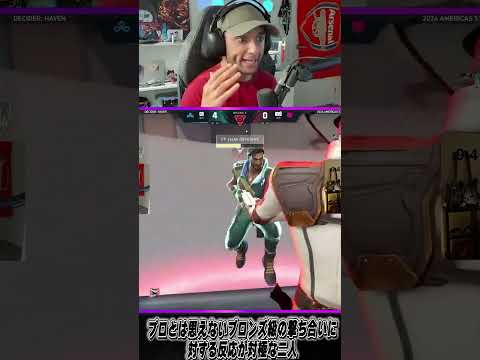
▶ Watch the original YouTube video
Two Pro Valorant Players Show Starkly Different Mental Responses to Bronze-Level Play
A video comparing two professional Valorant players’ reactions to low-rank gameplay reveals a critical divide in mental control and analytical thinking. While one player responds with shock and disbelief, the other remains calm and analytical—a difference that may predict long-term career success in esports.
What Happened
A viral video shows two professional Valorant players watching and reacting to Bronze-rank gameplay—the lowest tier in Valorant’s ranking system. Their responses could not be more different. One player exclaims in shock, expressing disbelief at what they are witnessing. The other maintains composure, analyzing the situation with a critical but measured perspective. This stark contrast in emotional response to the same scenario has sparked significant discussion within the esports community about what these reactions reveal about professional player psychology.
Why It Matters
The difference in these reactions goes far beyond personality. It reflects fundamental differences in mental discipline, analytical capability, and long-term career sustainability in professional gaming. Mental control has become increasingly recognized as a critical factor in esports success, often rivaling mechanical skill in importance. Understanding how top players process unexpected or seemingly illogical gameplay can offer insights into what separates elite performers from the rest, and what determines which professionals maintain stable careers versus those who burn out.
Background
Valorant, released in 2020, has rapidly become a major esports title with a complex competitive ecosystem. The game’s ranking system consists of eight tiers: Iron, Bronze, Silver, Gold, Platinum, Diamond, Immortal, and Radiant. Bronze represents near-beginner level play, making the skill gap between Bronze and professional players enormous. However, this gap creates an interesting laboratory for studying how professionals interpret and learn from lower-level gameplay.
The importance of mental control in esports has grown significantly in recent years. Major professional teams now employ dedicated mental coaches, recognizing that psychological resilience and analytical thinking are as crucial as raw mechanical skill. This shift reflects a maturation of the esports industry and a deeper understanding of what drives sustained competitive success.
Key Points
- Contrasting Reactions: Two professional players exhibit fundamentally different emotional and analytical responses to identical Bronze-level gameplay—one emotional and shocked, the other calm and analytical.
- Mental Maturity Levels: The difference in responses suggests varying degrees of mental development and emotional regulation, even among professional-tier players.
- Learning Orientation: The analytical player treats lower-rank play as a learning opportunity, while the emotional player dismisses it as incomprehensible, affecting their capacity for growth.
- Career Sustainability: Historical analysis of professional players suggests that those who maintain analytical composure experience more stable long-term careers and lower burnout rates.
- Valorant-Specific Factors: Valorant’s complex economy system and agent selection mechanics make emotional decision-making particularly costly, making mental control more critical than in other FPS titles.
- Industry Trend: The rise of professional mental coaching across esports indicates that teams increasingly view psychological training as essential to competitive success.
Timeline
- 2020: Valorant launches, establishing itself as a major esports title with emphasis on strategic decision-making alongside mechanical skill.
- 2021-2022: Professional esports organizations begin systematically hiring mental coaches and implementing psychological training programs.
- 2023: Analysis of VCT (Valorant Champions Tour) winners reveals that successful teams consistently demonstrate calm, analytical responses to adversity.
- Present: Video of contrasting professional player reactions generates community discussion about mental control in esports.
Perspectives
The Analytical Perspective: The calm, analytical response represents a mature approach to competitive gaming. This player treats unexpected or illogical plays as data points to understand, asking “why did they make that decision?” rather than dismissing the play as incomprehensible. This mindset enables continuous learning and adaptation, treating lower-rank play as a window into different strategic thinking.
The Emotional Perspective: The shocked, emotional response reflects genuine engagement with the game and frustration at suboptimal play. Some argue this emotional investment demonstrates passion and dedication. However, this response can limit learning opportunities by categorizing plays as “wrong” rather than “different,” potentially missing novel strategies or unconventional approaches that might later become meta.
Community Response: Online reactions have been mixed. YouTube comments express surprise that professional players respond so differently to the same content. Twitter discussions from esports analysts emphasize that mental control correlates with long-term career stability. Reddit and forum discussions acknowledge both perspectives as valid expressions of personality, while noting that analytical composure appears more conducive to sustained professional success.
Insights
This video illustrates a fundamental principle in professional esports: mechanical skill alone does not determine long-term success. The difference between these two professionals is not their ability to execute game mechanics—both are clearly elite players. Rather, the difference lies in their psychological approach to learning and adaptation.
The analytical player’s approach aligns with established principles from cognitive behavioral therapy and learning science. By suspending judgment and seeking to understand rather than evaluate, this player maintains cognitive flexibility and continues to extract value from all competitive experiences. This mindset reduces psychological stress, as the player frames losses and unexpected plays as learning opportunities rather than threats.
The emotional player’s response, while understandable, may contribute to long-term career challenges. Repeated emotional reactions to perceived mistakes can accumulate psychological stress, potentially leading to burnout—a documented issue among professional esports players. Additionally, dismissing lower-rank play as incomprehensible closes off potential sources of innovation and strategic insight.
Historical analysis supports this distinction. Professional players who maintain analytical composure tend to have longer careers, more stable performance, and greater adaptability to meta shifts. Conversely, players who rely heavily on emotional intensity often experience shorter career spans and greater volatility in performance.
For aspiring competitive players, this video offers a practical lesson: developing the habit of asking “why?” rather than expressing shock at unexpected plays accelerates skill development and improves mental resilience. This approach transforms every match—regardless of opponent rank—into a learning opportunity rather than a validation of superiority.
The broader implication is that esports maturity, both at the individual and organizational level, increasingly depends on psychological sophistication. As the industry continues to professionalize, mental training will likely become as standardized as mechanical practice, fundamentally reshaping how professional players develop and sustain their careers.