▶ Watch the original YouTube video
How Mobile Games Treat Free Characters Differently: A Parody Analysis of The Battle Cats
A popular parody video about The Battle Cats reveals a persistent psychological phenomenon in mobile gaming: free characters receive dramatically different treatment from paid characters, even when their actual in-game performance is comparable. This disparity reflects deeper issues within mobile game design and player psychology that have evolved over the past decade.
What Happened
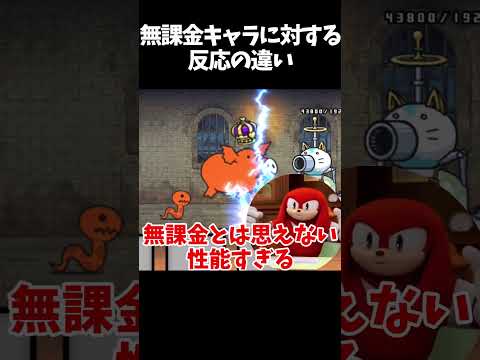
A parody video titled “Reactions to Free Characters with Knuckles” has gained attention in The Battle Cats community for satirizing how players treat free-to-obtain characters differently from premium characters. The video uses the character Knuckles—a free character in The Battle Cats—to illustrate the stark contrast in how the gaming community perceives and discusses free versus paid characters, despite their actual gameplay utility being comparable in many scenarios.
Why It Matters
This parody exposes a fundamental psychological bias that permeates the mobile gaming industry. The disparity in how players value free versus paid characters isn’t merely a reflection of game balance—it reveals how player psychology, investment mentality, and community dynamics shape perception of in-game value. Understanding this phenomenon is crucial for both game developers seeking to create inclusive experiences and players hoping to maximize their enjoyment regardless of spending habits.
Background
The Battle Cats is a tower defense game developed by Ponos, a Japanese company, and has maintained a large player base since its 2012 release. Like most modern mobile games, it employs a gacha system where premium characters can be obtained through paid currency, while free characters are distributed through gameplay or limited-time events. The game’s design creates an inherent hierarchy between paid and free content, a pattern common across the mobile gaming industry.
This phenomenon is not unique to The Battle Cats. Over the past 15 years, mobile gaming has evolved through distinct phases in how it treats free versus paid characters. During the 2013-2017 period, the gap between free and paid characters was often extreme, with some games making certain stages virtually impossible without premium characters. By 2017-2021, developers began recognizing that excessive gaps drove away free players entirely, leading to industry-wide balance adjustments. The current era (2021-present) emphasizes “coexistence strategies,” where free and paid characters occupy different roles rather than competing directly.
Key Points
- Psychological Bias Over Game Balance: Players evaluate free characters less favorably than paid characters even when objective performance metrics are similar, driven by cognitive biases rather than actual gameplay differences.
- Three Core Psychological Mechanisms: The illusion of rarity (paid characters feel more valuable due to acquisition difficulty), investment psychology (players unconsciously believe characters they paid for are stronger), and intentional game design (developers often make paid characters objectively stronger to encourage spending).
- Community Perception Gap: Social media discussions heavily favor paid characters, creating a feedback loop where paid character owners dominate community conversations, making free characters appear less viable.
- Industry Variation: Some games like Fate/Grand Order buck the trend by genuinely respecting free-to-play players, demonstrating that alternative business models are viable.
- Skill Demonstration Value: Completing difficult content with free characters has become a form of skill proof in advanced gaming communities, suggesting a potential shift in how free characters are valued.
- Parody as Industry Critique: The video functions as constructive criticism, with some game developers acknowledging that such satire indicates design problems worth addressing.
Timeline
- 2012: The Battle Cats launches with gacha mechanics that establish hierarchy between free and paid characters.
- 2013-2017: Mobile gaming industry emphasizes paid character superiority; free characters treated as “beginner content.”
- 2017-2021: Industry recognizes free player exodus problem; widespread balance adjustments implemented across major titles.
- 2021-Present: Shift toward “coexistence strategy” where free and paid characters serve different roles; parody video gains traction highlighting persistent psychological biases.
Perspectives
Player Community View: The parody resonated strongly with The Battle Cats community, with players on Twitter and Reddit describing the satirized treatment as “painfully accurate.” Many acknowledged experiencing the exact psychological phenomenon depicted—receiving sympathetic responses when using free characters versus admiring responses when using paid characters, despite achieving identical results.
Game Developer Perspective: Some developers have interpreted such parodies as constructive feedback, questioning whether their design philosophies inadvertently create unnecessary hierarchies. Others defend the current model as economically necessary, arguing that monetization requires some differentiation between free and paid content.
Competitive Community View: Advanced gaming communities have begun reframing free character usage as a skill demonstration. Completing high-difficulty content with free characters is increasingly recognized as evidence of superior strategy and game knowledge, potentially reversing the traditional hierarchy.
Business Model Analysis: The tension reflects a fundamental conflict in mobile gaming: maintaining profitability through premium monetization while retaining a healthy free-to-play player base that provides community engagement and potential future customers.
Insights
This parody video reveals that the mobile gaming industry faces a structural problem rooted not in game design but in human psychology. Even when developers create balanced experiences where free and paid characters are genuinely equivalent, players unconsciously assign higher value to paid characters based on investment psychology and perceived rarity.
The industry has evolved through three distinct phases: an early era of explicit pay-to-win mechanics, a correction phase addressing player exodus, and the current era attempting to create role-based coexistence. However, the parody demonstrates that psychological biases persist regardless of objective balance.
Looking forward, three trends appear likely: increased emphasis on respecting free-to-play players (as demonstrated by successful titles from companies like Nintendo and Cygames), greater character specialization where each character excels in specific roles rather than competing on raw power, and deeper community fragmentation as free and paid players develop separate evaluation frameworks.
The parody’s true value lies in functioning as a mirror for the gaming industry. By making invisible psychological biases visible through humor, it creates space for both developers and players to recognize and potentially address these patterns. For individual players, the insight is empowering: the achievement of completing difficult content with free characters represents genuine skill, and the satisfaction from such accomplishments often exceeds that of paid-character victories.
Ultimately, this phenomenon reflects a broader human tendency to assign higher value to things we’ve invested in, regardless of objective merit. The mobile gaming industry’s challenge is designing systems that acknowledge this psychological reality while still creating genuinely inclusive experiences for all player types.