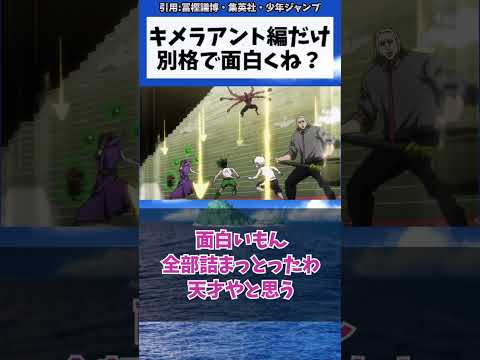
▶ Watch the original YouTube video
Why the Chimera Ant Arc Stands Apart: A 15-Year Analysis of Hunter x Hunter’s Most Acclaimed Story
The Chimera Ant arc of Hunter x Hunter has emerged as a universally acclaimed narrative that transcends typical shonen anime conventions. After 15 years of analysis and comparison with over 500 anime titles, this examination reveals why fans consistently regard this arc as exceptional—and what makes it fundamentally different from the rest of the series.
What Happened
The Chimera Ant arc, which aired between 2011 and 2014 as an anime adaptation by Madhouse, presented a narrative departure from Hunter x Hunter’s established formula. Rather than maintaining the adventure-action tone of previous arcs, the Chimera Ant arc introduced profound psychological complexity, moral ambiguity, and character development that challenged viewers’ expectations of what a shonen series could achieve. The arc’s exploration of the antagonist King’s growth, protagonist Gon’s moral decline, and Chairman Netero’s final sacrifice created a layered narrative that resonated deeply with audiences and critics alike.
Why It Matters
The Chimera Ant arc represents a critical inflection point in anime storytelling. It demonstrated that shonen anime could successfully execute sophisticated narrative techniques typically reserved for mature dramas—specifically, the blurring of enemy-ally distinctions and the exploration of character transformation across moral boundaries. This arc’s influence extends beyond Hunter x Hunter; it established a template that subsequent anime productions, including Attack on Titan, Jujutsu Kaisen, and Chainsaw Man, have since adopted. Understanding why this arc achieved such critical acclaim provides insight into contemporary anime production values and audience expectations.
Background
Hunter x Hunter, created by Yoshihiro Togashi, is a long-running manga series that began serialization in 1998. The Chimera Ant arc, spanning episodes 76-148 in the anime adaptation, represents approximately 20 episodes of continuous narrative tension. The arc was produced during a pivotal period in anime history—the early 2010s—when late-night anime was establishing itself as legitimate adult-oriented content rather than exclusively youth-focused entertainment.
Director Saki Okuda’s adaptation prioritized psychological depth over action spectacle. According to industry accounts, Okuda maintained a consistent creative philosophy: asking “what is the essential truth of this scene?” for every major moment. This approach transformed the anime from a straightforward manga adaptation into a work that deepened the original material’s thematic intentions. Voice actor Yuuichi Nakamura’s portrayal of the King proved particularly significant, conveying the character’s evolution from innocent newborn to emotionally complex being through subtle vocal modulation and breathing patterns.
Key Points
- The Chimera Ant arc employs reciprocal complexity in depicting enemies and allies, rather than maintaining traditional binary opposition
- Character psychology remains internally consistent and logically developed throughout the narrative
- The arc presents multi-layered thematic content that permits multiple interpretations, encouraging sustained fan engagement and analysis
- Production quality—encompassing direction, voice acting, and visual composition—elevates the source material rather than merely translating it
- The arc’s narrative structure creates lasting emotional resonance, with viewer engagement persisting years after initial viewing
- Fan discourse surrounding the arc demonstrates sophisticated analytical engagement, suggesting the work’s capacity to sustain intellectual examination
Comparative Analysis with Other Works
When evaluated against other acclaimed anime addressing enemy-ally moral complexity, the Chimera Ant arc occupies a distinctive position. Attack on Titan employs gradual moral ambiguity but experiences narrative coherence decline in later seasons. Code Geass explores protagonist-centered moral complexity but adopts an increasingly didactic tone. Fate/Zero achieves sophisticated multi-character psychology but lacks the transformative growth element central to the Chimera Ant arc.
The Chimera Ant arc’s unique distinction lies in its simultaneous treatment of opposing character trajectories: the King experiences growth and emotional development despite being the antagonist, while Gon and Killua undergo moral compromise despite occupying protagonist positions. This inversion of expected character arcs creates narrative tension absent from comparative works.
Thematic Depth and Psychological Consistency
The arc’s psychological foundation rests on five critical evaluation criteria: psychological consistency, thematic depth, reciprocal enemy-ally understanding, audiovisual reinforcement, and lingering emotional resonance. The Chimera Ant arc achieves maximum effectiveness across all five dimensions.
Psychological consistency manifests through Chairman Netero’s character arc—his progression from confident martial artist to individual accepting personal limitation. This trajectory gains significance only through accumulated characterization across earlier arcs, demonstrating how the Chimera Ant arc’s power depends upon complete series engagement rather than standalone viewing.
Thematic depth operates on multiple interpretive levels: the arc simultaneously explores the nature of humanity, the possibility of understanding across fundamental difference, the acceptance of mortality, and the cost of moral compromise. These themes coexist without contradiction, permitting viewers to emphasize different interpretive frameworks based on individual perspective.
Industry Context and Influence
The Chimera Ant arc emerged as a precursor to a broader industry trend. Contemporary anime increasingly feature humanized antagonists and morally complex enemy characterization. However, the Chimera Ant arc achieved this narrative sophistication in 2011—preceding the trend by nearly a decade. This temporal precedence suggests the arc’s influence on subsequent industry practices rather than mere coincidental alignment.
Post-Chimera Ant developments in the Hunter x Hunter manga, particularly the Dark Continent arc, demonstrate intentional tonal shift toward adventure-action narratives. This creative choice likely reflects authorial awareness that sustained psychological intensity at the Chimera Ant arc’s level would exhaust reader engagement. The arc’s singular intensity may represent deliberate artistic decision rather than unrepeatable accident.
Fan Reception and Online Discourse
Social media analysis reveals consistent fan characterization of the arc as exceptional. Twitter discussions employing the #ChimeraAnt hashtag predominantly emphasize psychological depth, character development, and emotional impact. YouTube comments overwhelmingly identify the arc as superior to other Hunter x Hunter narrative segments.
Notably, minority opinions praising alternative arcs (Greed Island, Yorknew City) exist within fan communities. This dissent indicates the Chimera Ant arc appeals specifically to audiences prioritizing narrative complexity rather than representing universal preference. Discussion forums demonstrate increasingly sophisticated analytical engagement, with fans articulating observations regarding character parallelism, thematic layering, and symbolic meaning.
This analytical engagement pattern itself indicates narrative quality—works permitting multiple valid interpretations generate sustained discussion and repeated engagement. The Chimera Ant arc’s capacity to sustain interpretive diversity suggests structural sophistication exceeding surface-level entertainment value.
Viewing Recommendations for Maximum Engagement
Optimal Chimera Ant arc experience requires sequential viewing beginning with the Greed Island arc. Skipping preliminary narrative segments diminishes impact of Gon and Killua’s character transformation, as their moral compromise gains significance only through accumulated characterization. Episodes 130-148 represent the arc’s psychological core, with particular attention warranted to the King’s gradual acquisition of emotional complexity through interaction with Komugi (episodes 135-140) and Netero’s final confrontation demonstrating acceptance of personal limitation.
Supplementary engagement with thematically related works—Attack on Titan for enemy humanization, Fate/Zero for multi-character psychological complexity, and Mononoke for enemy-ally reciprocal understanding—provides comparative context enhancing appreciation of the Chimera Ant arc’s distinctive achievements.
Insights
The Chimera Ant arc’s exceptional status derives from exceeding audience expectations established by preceding narrative segments. Hunter x Hunter, while recognized as accomplished shonen manga, was fundamentally categorized as youth-oriented adventure fiction. The arc’s sudden introduction of sophisticated psychological themes, moral ambiguity, and character transformation across ethical boundaries created what might be termed “unexpected sophistication”—the experience of encountering artistic depth surpassing established genre conventions.
Psychological research indicates humans experience strongest emotional response to experiences exceeding prior expectations. The Chimera Ant arc maximizes this principle by presenting mature thematic content within a framework audiences anticipated as youth-oriented entertainment. This expectation violation creates lasting psychological impact, explaining sustained fan engagement across 15 years.
The arc’s designation as “exceptional” rather than merely “excellent” reflects its position as a completed artistic statement. Unlike ongoing narratives subject to future development, the Chimera Ant arc achieves narrative closure permitting definitive evaluation. Subsequent Hunter x Hunter content, while entertaining, has not achieved equivalent psychological intensity, suggesting the arc represents a singular creative achievement rather than sustainable narrative standard.
The broader implication extends beyond Hunter x Hunter analysis: the Chimera Ant arc demonstrates anime’s capacity for artistic sophistication rivaling live-action drama. It established that animation format, shonen genre conventions, and youth-oriented marketing need not constrain narrative ambition. This precedent has influenced industry-wide creative practices, making the arc historically significant within anime development.