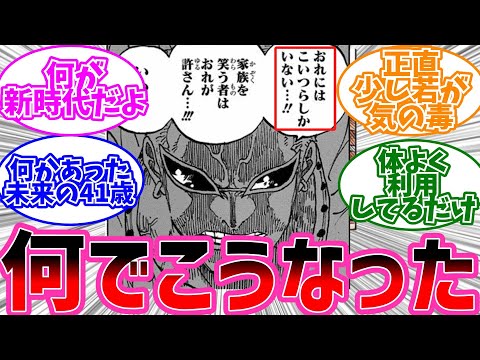
▶ Watch the original YouTube video
Doflamingo vs. Crocodile: How One Piece’s Greatest Villain Contrast Reveals the Series’ Evolution
After 15 years of following One Piece, fans and analysts are recognizing a profound contrast between two of the series’ most complex antagonists: Crocodile and Doflamingo. This comparison reveals not just the difference between two villains, but the fundamental evolution of creator Eiichiro Oda’s storytelling approach and the deepening sophistication of the fanbase’s critical analysis.
What Happened
The One Piece community has begun engaging in detailed comparative analysis of Crocodile, the primary antagonist of the Alabasta arc (2003), and Doflamingo, the central villain of the Dressrosa arc (2013). This discussion, amplified through social media and fan communities, highlights how these two characters represent fundamentally different archetypes of villainy and reflect the narrative’s progression from localized conflicts to global-scale conspiracies.
Why It Matters
This contrast matters because it demonstrates how long-running serialized fiction evolves in complexity and thematic depth. The comparison between Crocodile and Doflamingo serves as a lens through which to understand not only character development but also the maturation of the fanbase’s interpretive capabilities. It reveals how One Piece has transitioned from a straightforward adventure narrative into a sophisticated exploration of power structures, governance, and the nature of freedom itself.
Background
Crocodile first appeared in the Alabasta arc as a calculating antagonist with a clear, limited objective: to destabilize the nation of Alabasta through internal conflict and seize control. His methods were logical and emotionally detached, relying on careful planning and manipulation of political circumstances. Doflamingo, introduced over a decade later in the Dressrosa arc, operates on a different principle entirely. As a member of the Seven Warlords of the Sea and a covert agent of the World Government, he maintains surface-level order while simultaneously manipulating multiple nations and power structures from behind the scenes. Unlike Crocodile’s straightforward ambition, Doflamingo appears to derive satisfaction from the act of control itself—treating power as a game rather than a means to an end.
Key Points
- Crocodile as Destroyer: Represents a villain motivated by personal ambition to control a single nation through calculated chaos and political manipulation.
- Doflamingo as Manipulator: Embodies a more complex antagonist who maintains systemic order while secretly controlling multiple factions, treating power as entertainment.
- Evolution of Narrative Scope: Crocodile’s localized threat reflects One Piece’s early focus on individual island adventures, while Doflamingo’s global influence mirrors the series’ expansion into world-scale conspiracies.
- Philosophical Depth: Crocodile’s dialogue centers on personal ambition, while Doflamingo’s conversations explore abstract concepts like freedom, the nature of the world, and the definition of power itself.
- Voice Acting as Character Definition: Crocodile’s voice actor emphasizes cold calculation through restrained delivery, while Doflamingo’s portrayal highlights chaotic enjoyment through expressive, theatrical performance.
- Relationship to Luffy: Crocodile functions as a localized enemy defeated in a single arc, whereas Doflamingo operates as a recurring nemesis whose influence extends across multiple story arcs and connects to the protagonist’s broader history.
Timeline
- 2003: Crocodile introduced in Alabasta arc as primary antagonist with goal of national conquest.
- 2009: Fifteen-year retrospective period begins, with increased fan analysis of character development.
- 2013: Doflamingo introduced in Dressrosa arc, representing evolved villain archetype.
- Present: Fan communities recognize and analyze the contrast between these two antagonists as reflection of series’ narrative evolution.
Perspectives
Fan communities present multiple interpretations of this contrast. Some view Doflamingo as an evolutionary advancement of Crocodile’s archetype—a more sophisticated version of the same villain type. Others argue they represent fundamentally different categories of antagonists, with Crocodile embodying “realistic” villainy grounded in political ambition, while Doflamingo represents a more fantastical, sadistic form of evil that transcends rational motivation.
Critical analysis on social media platforms reveals that the fanbase has matured beyond simple “strong vs. weak” comparisons. Twitter discussions emphasize the philosophical distinction between a “destroyer” and a “controller,” while YouTube comments debate whether Doflamingo’s chaotic nature represents genuine character development or a departure from the grounded villainy established by Crocodile.
Some viewers express concern that Doflamingo’s theatrical madness sacrifices the realism that made Crocodile compelling, while others argue that this shift reflects One Piece’s intentional movement toward exploring the abstract nature of power and freedom rather than merely depicting personal ambition.
Insights
The Crocodile-Doflamingo contrast illuminates several broader truths about One Piece’s narrative architecture. First, it demonstrates Eiichiro Oda’s deliberate progression in villain complexity: from simple personal ambition (early antagonists like Buggy and Kuro), through political scheming (Crocodile), to systemic manipulation and philosophical nihilism (Doflamingo). This trajectory suggests the series is fundamentally concerned with power structures rather than individual strength.
Second, the contrast reveals the fanbase’s intellectual maturation. Early One Piece audiences evaluated characters through binary judgments of likability. Contemporary fans engage in structural analysis, comparing character motivations, examining thematic significance, and tracing narrative patterns across decades of storytelling. This shift indicates that long-running serialized fiction develops alongside its audience, creating increasingly sophisticated interpretive communities.
Third, the comparison suggests that One Piece functions simultaneously as adventure fantasy and political allegory. Crocodile’s localized conspiracy reflects the series’ early focus on individual islands and contained conflicts. Doflamingo’s involvement with the World Government and his influence across multiple nations mirrors One Piece’s expansion into examination of global power imbalances and institutional corruption. The series has evolved from asking “Can Luffy defeat this enemy?” to asking “What is the nature of freedom in a world structured by systemic oppression?”
Finally, the voice acting choices—Crocodile’s restrained delivery versus Doflamingo’s theatrical expression—demonstrate how production decisions reinforce thematic intent. The production team’s deliberate differentiation of these characters through vocal performance suggests conscious design rather than coincidence, indicating that even technical production choices serve the larger narrative purpose of contrasting villain archetypes.