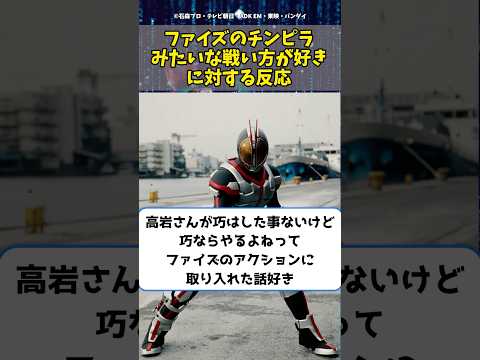
▶ Watch the original YouTube video
Why Kamen Rider Faiz’s Unconventional Fighting Style Became a Game-Changer in Tokusatsu
Kamen Rider Faiz broke the mold of traditional superhero narratives by presenting a protagonist who fights reluctantly and ungracefully, prioritizing psychological depth over heroic spectacle. This analysis explores how the series’ “delinquent-like” combat approach revolutionized character development in tokusatsu and influenced an entire generation of subsequent productions.
What Happened
Kamen Rider Faiz (also known as Kamen Rider 555), which aired in 2004, introduced a fundamentally different approach to the tokusatsu hero archetype through its protagonist Kiba Yuuji. Rather than embodying the traditional image of a righteous young man eagerly fighting against overwhelming odds, Kiba is forced into the role of a Kamen Rider against his will. This reluctance manifests directly in his combat style: ungainly movements, defensive posturing, repeated strikes rather than elegant techniques, and visible emotional vulnerability. The series deliberately eschewed the polished, heroic presentation that had defined the franchise for decades.
Why It Matters
Faiz’s approach represented a significant shift in how tokusatsu and superhero narratives could portray their protagonists. By centering psychological authenticity over heroic idealism, the series demonstrated that audiences could connect more deeply with flawed, reluctant heroes than with traditional paragons of virtue. This innovation had lasting consequences: nearly every Kamen Rider series produced after 2004 adopted variations of the “reluctant hero” framework. The show’s influence extended beyond tokusatsu into broader anime and entertainment discourse about character development and narrative authenticity. For viewers and critics, Faiz proved that “weakness” and “ungainliness” could be more compelling than traditional strength and grace.
Background
The Kamen Rider franchise, which began in 1971, had established a consistent formula: a young protagonist discovers or is granted the power to transform into a masked warrior and uses that power to defend society against evil organizations. Throughout the 1970s, 1980s, and 1990s, variations on this theme maintained the core expectation that the protagonist would eventually embrace their role and grow into their heroic potential.
By the early 2000s, Japanese society and entertainment culture were shifting. The rise of non-traditional employment, the decline of lifetime employment guarantees, and broader cultural skepticism toward institutional authority created an audience less responsive to straightforward heroic narratives. Faiz emerged during this transitional period, reflecting contemporary anxieties about being trapped in unwanted circumstances and forced into roles one did not choose.
The series’ creative team deliberately rejected the “demythologization of the Rider” concept—positioning Kiba not as someone who would eventually accept his role, but as someone who would remain fundamentally resistant to it throughout the narrative. This resistance became the defining characteristic of his combat approach.
Key Points
- Reluctant protagonist: Kiba Yuuji fights not out of conviction or heroic impulse, but because he is coerced by an organization. This unwillingness shapes every aspect of his combat behavior.
- Ungraceful combat style: Rather than executing polished techniques, Kiba retreats, stumbles, rolls, and repeatedly strikes opponents in a manner resembling street fighting rather than choreographed heroics.
- Psychological authenticity: The suit actor’s physical performance conveys fear, frustration, helplessness, and resignation through body language, creating emotional depth despite the masked format.
- Absence of traditional growth: Unlike subsequent reluctant heroes who eventually embrace their role, Kiba never fundamentally changes. His discomfort with being a Kamen Rider persists to the narrative’s conclusion.
- Lasting influence: Subsequent series including Kamen Rider W (2009), Kamen Rider Gaim (2013), Kamen Rider Drive (2014), and Kamen Rider Ghost (2015) all adopted variations of the reluctant hero framework, establishing it as the new standard.
- Social commentary: The series reflected early 2000s Japanese anxieties about non-traditional employment and institutional coercion, functioning as cultural commentary alongside entertainment.
Timeline
- 2004: Kamen Rider Faiz airs, introducing the reluctant hero protagonist and unconventional combat style.
- 2006: Anime series like “The Melancholy of Haruhi Suzumiya” popularize psychological depth as a narrative priority in Japanese entertainment.
- 2009: Kamen Rider W airs, adopting the reluctant hero framework while adding elements of character growth and partnership dynamics.
- 2013: Kamen Rider Gaim airs, featuring a protagonist forced into combat who gradually develops awareness of his role as a Rider.
- 2014-2015: Kamen Rider Drive and Kamen Rider Ghost continue the reluctant hero tradition, cementing it as the post-Faiz standard.
Perspectives
Enthusiast perspective: Fans and critics who appreciate Faiz view its “ungainly” and “gritty” qualities as sophisticated character work. They argue that the series achieved unprecedented psychological authenticity by allowing combat choreography to directly reflect the protagonist’s mental state. For these viewers, Kiba’s reluctance and physical awkwardness represent the series’ greatest artistic achievement.
Traditional tokusatsu perspective: Some viewers accustomed to conventional Kamen Rider presentations found Faiz underwhelming. Critics in this camp described the combat as “dull,” the protagonist as “weak,” and the overall narrative as overly complex. This perspective values the heroic spectacle and clear moral clarity of earlier series.
Industry analysis perspective: Production scholars and tokusatsu historians recognize Faiz as a watershed moment that fundamentally altered franchise direction. Rather than viewing it as superior or inferior to earlier works, this perspective emphasizes its historical significance as a turning point that enabled greater narrative diversity in subsequent productions.
Comparative media perspective: When compared to contemporary anime like “Neon Genesis Evangelion” (which also featured a psychologically coerced protagonist), Faiz differs in that Kiba accepts his circumstances with resignation rather than psychological breakdown. This distinction makes Faiz more relatable to audiences while maintaining thematic depth.
Insights
Kamen Rider Faiz’s significance extends beyond its immediate entertainment value. The series demonstrated that tokusatsu and superhero narratives could prioritize psychological authenticity and character interiority without sacrificing audience engagement. By making the protagonist’s reluctance and emotional vulnerability visible through physical performance, Faiz proved that “weakness” could be dramatically compelling.
The series’ lasting influence suggests a broader cultural shift in how audiences relate to protagonists. The “perfect hero” archetype gave way to the “flawed, reluctant hero” as the dominant narrative model. This shift reflected real social changes—the decline of institutional loyalty, the rise of precarious employment, and growing skepticism toward authority—making Faiz not merely an entertainment product but a cultural artifact that captured its historical moment.
However, the very success of Faiz’s formula raises questions about creative saturation. Nearly every Kamen Rider series since 2004 has adopted variations of the reluctant hero framework, potentially limiting narrative innovation. The question for future tokusatsu production is whether the psychological depth pioneered by Faiz can be evolved further, or whether new paradigms remain to be discovered.
Ultimately, Faiz’s “delinquent-like” fighting style represents a deliberate artistic choice to privilege character psychology over spectacle. In doing so, it expanded the emotional and thematic range of what tokusatsu could achieve, proving that ungraceful, reluctant heroism could be more profoundly human—and more artistically valuable—than traditional heroic idealism.