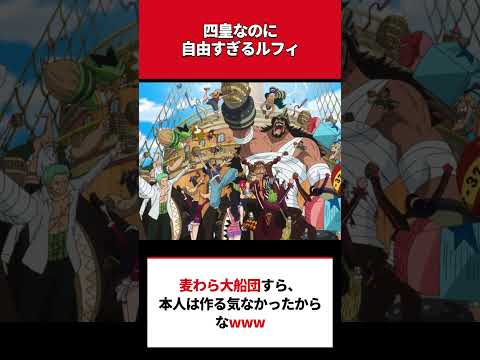
▶ Watch the original YouTube video
After 15 years of following One Piece, fans continue to marvel at an unusual phenomenon: Luffy’s freedom and unpredictability have only intensified since achieving Yonko status, defying the typical character arc where power brings responsibility and constraint. This analysis explores why Luffy stands apart from other anime protagonists and what his unwavering commitment to freedom reveals about One Piece’s core philosophy.
What Happened
Luffy, now recognized as one of the Four Emperors (Yonko), continues to behave with the same carefree abandon and unpredictability he displayed as an unknown pirate. Rather than becoming more cautious or strategic with his newfound status—as most protagonists do—Luffy’s freedom of action has paradoxically increased. This contradiction between his position as a world-class threat and his seemingly reckless behavior has become a focal point for fan discussion and analysis.
Why It Matters
Luffy’s character represents a fundamental departure from conventional protagonist development in anime and manga. While characters like Naruto, Ichigo, and Deku grow more thoughtful and constrained by responsibility as they gain power, Luffy’s trajectory suggests that true freedom cannot be diminished by external status or authority. This distinction carries philosophical weight, exploring what freedom actually means and whether power necessarily limits individual liberty. For audiences, Luffy embodies an idealized version of personal autonomy that resonates across cultures and age groups.
Background
One Piece began serialization in 1997, and by 2008—when this analysis’s author first encountered the series—Luffy had already fought numerous powerful enemies and gathered a substantial crew. What struck the observer most was that Luffy’s fundamental character remained unchanged: his commitment to freedom had not diminished despite growing strength and responsibility. This consistency over more than 15 years of narrative development is statistically rare in long-running shonen manga.
Creator Eiichiro Oda has explicitly stated in interviews that Luffy embodies the purest expression of the concept of “freedom” that he wished to convey. The animation direction consistently emphasizes this through exaggerated movements and expressive facial animations that distinguish Luffy from other characters. Voice actress Mayu Tanaka has noted that she deliberately maintains an unpredictable quality in Luffy’s performance to capture this essence of freedom.
Key Points
- The Paradox of Power: Luffy’s Yonko status contradicts his carefree behavior, yet this contradiction is intentional rather than inconsistent with his character.
- Crew Reactions: Allies like Nami, Usopp, and Robin frequently find themselves bewildered and exasperated by Luffy’s unpredictable actions, suggesting his freedom creates genuine narrative tension.
- Enemy Vulnerability: Even powerful adversaries struggle to counter Luffy’s unpredictability, as their strategic planning becomes ineffective against his freedom-based approach.
- Freedom as Strategy: What appears to be recklessness may actually represent a sophisticated tactical approach—using psychological unpredictability as a weapon.
- Philosophical Consistency: For Luffy, “freedom” is not a phase to outgrow but the core value that supersedes power, status, and authority.
- Contrast with Other Protagonists: Unlike Lelouch from Code Geass or Light from Death Note, who become increasingly constrained by their power, Luffy’s freedom expands with his influence.
Comparative Analysis: Why Luffy Stands Alone
When examined alongside other major anime protagonists, Luffy’s uniqueness becomes apparent. Naruto gradually becomes bound by his role as Hokage and protector of the Hidden Leaf Village. Eren from Attack on Titan’s definition of freedom becomes corrupted and distorted as he pursues power. Lelouch from Code Geass becomes increasingly trapped by his own authority. Yet Luffy’s definition of freedom remains constant and uncompromised, regardless of circumstance.
This distinction suggests that Luffy does not pursue power for its own sake. The Yonko status represents “freedom recognized by the world,” not a constraint upon it. This fundamental difference in motivation explains why Luffy can achieve unprecedented status while maintaining his essential character.
The Strategic Dimension of Freedom
A deeper analysis reveals that Luffy’s apparent lack of planning may constitute a sophisticated tactical approach. His unpredictability functions as a psychological weapon, destabilizing opponents who rely on strategic calculation. In his battle against Doflamingo, for instance, Luffy’s seemingly reckless attacks served to undermine his opponent’s confidence in his own perfect planning. This represents a form of warfare based on transcending predictability itself—a principle found in classical strategy but rarely weaponized so effectively in modern narrative.
Recent anime trends show protagonists becoming more strategic with experience, as seen in Jujutsu Kaisen and Chainsaw Man. Luffy inverts this pattern: rather than learning conventional tactics, he weaponizes freedom itself, suggesting a more fundamental approach to conflict resolution.
Production Intent and Creative Philosophy
The consistency with which Luffy’s freedom is portrayed across animation, voice acting, and narrative suggests deliberate creative intent. Oda’s philosophy appears to propose that power and freedom are not inherently opposed—that authority can serve as a vehicle for expanded liberty rather than its negation. This represents a philosophical stance distinct from most contemporary narratives, which typically frame power as corrupting or constraining.
The animation team’s choice to render Luffy with larger, more dynamic movements and more expressive features than other characters reinforces this thematic emphasis. This visual language communicates freedom as a fundamental quality rather than a temporary state.
Fan Reception and Cultural Resonance
Social media analysis reveals widespread engagement with this theme. Twitter discussions frequently highlight the contradiction between Luffy’s status and behavior with phrases like “A Yonko but still completely free.” YouTube comments frequently elevate the observation that “Luffy’s growth is measured by increasing freedom rather than increasing power.” This resonance suggests the theme addresses a universal human concern: the fear that achievement and responsibility necessarily diminish personal autonomy.
For audiences navigating social constraints, family expectations, and professional obligations, Luffy’s unwavering commitment to freedom represents an aspirational ideal. His character suggests that one need not sacrifice core values upon achieving success.
Future Implications
If current patterns persist, Luffy’s ultimate achievement of Pirate King status may involve not merely becoming the strongest pirate, but fundamentally transforming the concept of piracy itself. The treasure One Piece may symbolize freedom in its purest form, and Luffy’s acquisition of it could represent the liberation of the world itself rather than personal enrichment.
This trajectory suggests that Luffy’s influence will eventually transcend individual achievement and become world-altering. The Yonko status represents a waypoint rather than a destination in his pursuit of ever-greater freedom.
Critical Evaluation Framework
Assessing Luffy against five critical dimensions yields exceptional results:
Consistency: Luffy’s values remain uncompromised across 15+ years of narrative, an achievement rare among major characters.
Growth: Rather than changing his nature, Luffy’s world expands to accommodate his unchanging values, inverting typical character development.
Influence: His impact on allies, enemies, and the world itself is profound and continuously expanding.
Uniqueness: No comparable character maintains freedom as an absolute value while ascending to supreme power.
Universality: The theme of freedom versus constraint resonates across cultural and demographic boundaries.
Insights
Luffy’s character arc represents a philosophical statement about the nature of freedom and power. Rather than accepting the conventional narrative that authority constrains liberty, One Piece proposes that freedom can be the foundation of power itself. This inversion of typical power dynamics suggests that true strength derives not from strategic calculation or ruthless ambition, but from unwavering commitment to core values.
The sustained consistency of Luffy’s character across 15+ years indicates that this is not accidental characterization but deliberate artistic vision. Oda’s creation challenges audiences to reconsider assumptions about how individuals should change when circumstances demand it. Luffy’s answer is simple: they should not, if their core values are true.
For contemporary audiences constrained by social expectation and professional obligation, Luffy offers a vision of power that liberates rather than confines. His Yonko status becomes not a burden but a platform for expanded freedom. This resonates because it addresses a fundamental human anxiety: that success requires the sacrifice of authenticity. Luffy suggests otherwise.