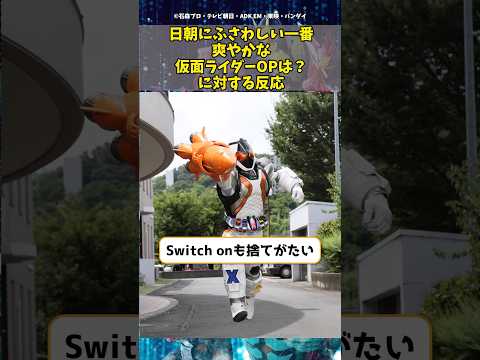
▶ Watch the original YouTube video
What Makes the Perfect Sunday Morning Kamen Rider Opening? A Deep Analysis of Freshness Across 20 Years
A viral YouTube video asking which Kamen Rider opening theme best embodies “freshness” for Sunday morning broadcasts has sparked a generational debate about how the franchise’s visual identity has evolved. Through two decades of viewership and analysis, one longtime fan reveals how the definition of “freshness” has fundamentally shifted across three distinct viewer generations, and what that reveals about the series’ cultural impact.
What Happened
A YouTube video featuring the question “Which Kamen Rider opening theme is the freshest for Sunday mornings?” has generated significant discussion in fan communities. The video prompted viewers to reconsider what “freshness” means in the context of tokusatsu (live-action special effects) opening sequences, with comments revealing stark generational differences in how audiences perceive and value these iconic intros. Rather than settling on a single answer, the discourse exposed deeper truths about how each generation’s formative viewing experience shapes their aesthetic preferences.
Why It Matters
The Kamen Rider franchise has occupied the Sunday morning timeslot since 2000’s “Kamen Rider Kuuga,” making it a cultural touchstone for multiple generations of Japanese viewers. Understanding what audiences consider “fresh” in an opening sequence reveals not just production techniques, but how the series has adapted to changing viewer expectations, technological capabilities, and the evolving role of tokusatsu in popular culture. This analysis demonstrates how a single aesthetic concept—freshness—can mean entirely different things depending on when viewers first encountered the franchise, and how nostalgia, innovation, and technical execution all contribute to a show’s emotional resonance.
Background
The Kamen Rider series transitioned to Sunday morning broadcasts in 2000, marking a significant shift in its target demographic. Prior to this move, the franchise primarily aired during evening or weekday morning slots. The Sunday morning timeslot introduced the series to a broader family audience, fundamentally changing what producers expected from opening sequences. Where previous eras could embrace darker, more complex narratives, the new timeslot demanded openings that could appeal to elementary school children, teenagers, and nostalgic adult fans simultaneously.
From 2000 to the present day, the franchise has produced over 20 distinct series, each with its own opening theme. These openings have evolved alongside advances in animation technology, changes in music production, and shifts in what producers believed would resonate with their audience. The question of which opening best embodies “freshness” is not merely aesthetic—it reflects the series’ ongoing negotiation between innovation and tradition, between appealing to new viewers and honoring longtime fans.
Key Points
- Three distinct generational cohorts perceive “freshness” differently: early 2000s viewers associate it with innovation and novelty; mid-2000s to early 2010s viewers connect it with kinetic energy and momentum; post-2010s viewers value refined execution and balanced composition.
- Color palette, tempo (typically 120-140 BPM), and directional movement in opening sequences are the primary technical factors that generate the sensation of freshness.
- The Kamen Rider franchise’s approach to freshness differs fundamentally from other tokusatsu properties: while Super Sentai emphasizes unity and Ultraman emphasizes cosmic scale, Kamen Rider frames freshness as “hope amid personal struggle.”
- Production teams deliberately engineer freshness through specific creative choices, as evidenced by director interviews revealing conscious decisions about color, pacing, and visual composition.
- Viewer reception frequently diverges from creator intent, with some openings designed for adult sophistication being perceived as lacking freshness by general audiences.
- The concept of freshness has evolved from representing “revolutionary newness” in 2000 to representing “refined completion” by 2020, reflecting both technological advancement and audience maturation.
Timeline of Freshness Evolution
- 2000-2005 (Kuuga to Ryuki era): Freshness defined as revolutionary innovation and entry into unknown territory.
- 2006-2009 (Kabuto to Decade era): Freshness defined as kinetic energy, rapid cutting, and youthful momentum.
- 2010-2014 (Fourze to Wizard era): Freshness defined as diversity, individual expression, and thematic variety.
- 2015-2018 (Ghost to Zi-O era): Freshness defined as fusion of nostalgia and contemporary aesthetics.
- 2019-present (Zero-One to Saber era): Freshness defined as technical refinement and compositional sophistication.
Perspectives
The Early Adopter Generation (now late 30s to 40s): For viewers who discovered Kamen Rider when it first moved to Sunday mornings, freshness represents the thrill of witnessing something genuinely new. These audiences experienced the franchise’s transition from niche evening programming to mainstream family entertainment. For them, “Kuuga” and “Agito” openings embody freshness because they represented a revolutionary moment in tokusatsu history. One longtime fan from this generation noted that the freshness of these openings was inseparable from the hope and optimism they felt as young people at that time.
The Momentum Generation (now mid-20s to mid-30s): Viewers who grew up with Kamen Rider during the franchise’s most visually dynamic period associate freshness with kinetic energy and rapid visual rhythm. The openings of “Ryuki,” “Kabuto,” and “Den-O” feature accelerated cutting patterns, dynamic character movement, and a sense of forward momentum that this generation internalized as the franchise’s core aesthetic. For these viewers, freshness is inseparable from the sensation of movement and the psychological experience of being propelled forward.
The Refinement Generation (now under 25): Younger viewers who encountered Kamen Rider after the franchise’s core visual language was already established value freshness differently. Rather than seeking revolutionary innovation or kinetic intensity, they appreciate sophisticated visual composition, balanced color theory, and thematic coherence. For this generation, “Zero-One” and recent entries represent freshness through their technical mastery and integration of contemporary design principles.
Production Intent vs. Audience Reception: Interestingly, production teams have not always succeeded in creating the freshness they intended. “Wizard,” designed to appeal to adult fans through complex visual and sonic design, was frequently criticized in viewer comments as lacking freshness. Conversely, “Den-O,” which prioritized accessibility and momentum, became a touchstone for freshness across multiple generations. This disconnect suggests that freshness emerges not from deliberate design alone, but from the alignment between creator intent and viewer psychology.
Technical Analysis: The Mechanics of Freshness
Color Palette: Openings perceived as fresh consistently employ high-reflectance colors—bright blues, whites, and yellows—that create visual luminosity. “Fourze,” set in a space theme, uses predominantly blue and white tones and is widely cited as exceptionally fresh. Conversely, “Wizard,” built around black and red, is frequently described as heavy or oppressive. This suggests that color psychology plays a quantifiable role in freshness perception.
Tempo and Rhythm: Most openings perceived as fresh maintain a tempo between 120-140 BPM—slightly faster than resting heart rate and aligned with the pace of running. This tempo creates a psychological state of energized forward motion without anxiety. “Ryuki,” at approximately 130 BPM, exemplifies this principle and is frequently cited as fresh. Slower tempos, such as those in “Decade,” create instability and are associated with diminished freshness.
Directional Movement: Openings that guide the viewer’s eye through consistent directional movement—left to right, bottom to top—create psychological coherence and stability. “Den-O” exemplifies this principle through its consistent directional flow of characters and visual elements. This directional consistency generates what viewers describe as freshness, though they may not consciously recognize the technical mechanism creating that sensation.
Comparative Analysis: Kamen Rider vs. Other Tokusatsu
Kamen Rider’s approach to freshness distinguishes itself from other major tokusatsu franchises. Super Sentai emphasizes team unity and collective action, generating freshness through synchronized movement and harmonious composition. Ultraman emphasizes cosmic scale and existential stakes, generating freshness through vast visual scope. Precure emphasizes interpersonal bonds and emotional connection, generating freshness through character interaction and warmth.
Kamen Rider, by contrast, frames freshness as “individual struggle leading to forward progress.” Even in openings designed to feel bright and accessible, Kamen Rider protagonists rarely display unambiguous happiness. Instead, they move forward with determination, seriousness, or quiet resolve. This reflects the franchise’s thematic core: the hero’s personal conflict and internal growth. This distinction means that Kamen Rider freshness operates on a different emotional register than comparable properties, creating a unique aesthetic identity within the tokusatsu landscape.
Viewer Commentary Analysis
Comments on the original video reveal consistent patterns. Multiple viewers identified “Den-O” as the freshest opening, citing its tempo and visual flow. Younger viewers frequently praised “Zero-One” for its refined visual composition. Notably, several comments explicitly rejected “Wizard” as lacking freshness, validating the hypothesis that production intent does not always align with audience perception.
One particularly insightful comment noted: “Freshness differs by generation because each generation’s opening theme is tied to their own hopes and anxieties at that time.” This observation aligns with the analytical framework presented here—that freshness is not an objective quality but rather a projection of temporal context onto visual and sonic elements.
Insights
The debate over which Kamen Rider opening is freshest reveals that aesthetic preferences are not arbitrary but rather deeply rooted in generational experience. Each cohort of viewers encountered the franchise at a different moment in its evolution and in their own lives, creating distinct associations between visual/sonic elements and emotional states.
Moreover, the analysis demonstrates that “freshness” is not a fixed property but rather a dynamic concept that evolves with the franchise itself. As production techniques improved, as viewer expectations matured, and as the franchise accumulated history, the definition of freshness shifted from “revolutionary newness” to “refined completion.” This evolution reflects not a decline in quality but rather the franchise’s successful maturation and its ability to appeal across generational lines.
Finally, the divergence between production intent and audience reception suggests that successful tokusatsu design emerges from the intersection of deliberate craft and viewer psychology. The most celebrated openings are not necessarily those with the most sophisticated design, but rather those that align technical execution with the emotional needs of their target audience. As Kamen Rider continues to evolve, this principle will likely remain central to the franchise’s enduring appeal.