▶ Watch the original YouTube video
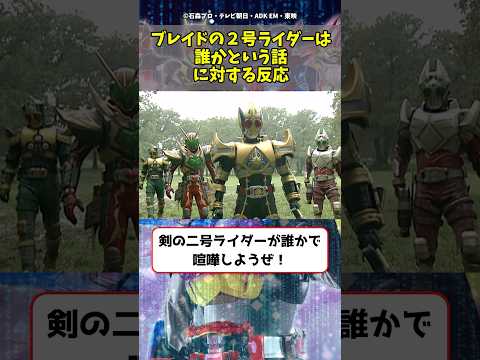
The question of who serves as the second rider in Kamen Rider Blade has sparked debate even among official sources, with Toei and Bandai offering conflicting definitions. This disagreement reveals deeper structural complexities in the series that challenge traditional Rider franchise conventions.
What Happened
Kamen Rider Blade presents an unusual problem within the franchise: there is no clear consensus on who the “second rider” actually is. Multiple candidates—including Garren, Chalice, Leangle, and Challenger—have legitimate claims to the title depending on how the role is defined. What makes this situation unique is that the disagreement extends beyond fan interpretation to official sources themselves, with Toei and Bandai apparently adopting different criteria for determining the second rider.
Why It Matters
The “second rider” has traditionally been a clearly defined role in the Kamen Rider franchise, typically representing the protagonist’s closest ally and the second most important warrior in the narrative. The absence of this clarity in Blade signals a fundamental shift in how the series structures its cast and storytelling. Understanding this ambiguity provides insight into how the franchise evolved during the Heisei era and what the series was attempting to achieve thematically.
Background
In earlier Kamen Rider series, the second rider was unambiguous. The original Kamen Rider 2 established the archetype: a clear ally to the protagonist with defined importance to both the narrative and combat hierarchy. However, by the time Blade aired, the franchise had begun experimenting with ensemble casts and morally complex characters. Blade took this experimentation to its logical extreme, creating a scenario where the protagonist is surrounded by multiple riders, none of whom fit the traditional second rider mold.
The series employs two distinct rider systems: the Blade System (used by protagonist Kazuma Kenzaki) and the Rouse System (used by other riders). This structural duality complicates any attempt to establish a clear hierarchy. Additionally, many of the riders occupy ambiguous moral positions—neither fully ally nor fully enemy—which further disrupts traditional role definitions.
Key Points
- Official disagreement: Toei and Bandai have adopted different definitions of “second rider,” suggesting the ambiguity is not accidental but structural.
- Multiple candidates exist: Garren, Chalice, Leangle, and Challenger all have legitimate claims depending on the criteria used (narrative importance, system hierarchy, ally status, or appearance order).
- Blurred moral boundaries: Unlike previous series, most riders in Blade occupy ambiguous positions between ally and enemy, making traditional categorization impossible.
- System complexity: The existence of the Joker card and the hierarchical nature of the Rouse System create alternative frameworks for determining rider importance.
- Protagonist isolation: The lack of a clear second rider emphasizes Kenzaki’s isolation—he remains the only rider truly committed to the “front” position throughout the series.
Candidate Analysis
| Rider Name | System | Allegiance | Second Rider Suitability |
|---|---|---|---|
| Blade (Kazuma Kenzaki) | Blade System | Protagonist | N/A |
| Garren (Hideyuki Kagawa) | Blade System | Ally | High (same system, but narratively secondary) |
| Chalice (Sakuya Tachibana) | Rouse System | Ally/Enemy (ambiguous) | Medium (different system, complex role) |
| Leangle (Hajime Aikawa) | Rouse System | Enemy | Low (primarily antagonistic) |
| Challenger | Multiple | Enemy | Low (antagonistic) |
Defining the Second Rider: Multiple Frameworks
The ambiguity stems from competing definitions of what “second rider” means:
- Narrative importance: Chalice emerges as the most story-critical rider, influencing the plot more than any other character besides Kenzaki.
- System hierarchy: Within the Rouse System, Chalice (Joker holder) and Leangle (King holder) occupy the highest positions, suggesting they could be considered “first” among the secondary riders.
- Ally status: Garren is the only consistently allied rider, making him the most traditional “second rider” by classic franchise standards.
- Appearance order: Challenger appears first chronologically, though this criterion seems least relevant to the discussion.
Perspectives
Fan discussions reveal three primary interpretive camps. The first argues for Chalice, citing narrative centrality and the symbolic importance of the Joker card within the Rouse System hierarchy. The second advocates for Garren, applying traditional franchise logic that the second rider should be the protagonist’s primary ally. The third proposes Leangle, pointing to his role as a major antagonist and the King card’s significance in the system.
The fact that official sources disagree suggests the series was deliberately constructed to resist simple categorization. Rather than a flaw, this may represent an intentional design choice to emphasize Kenzaki’s isolation and the series’ thematic focus on moral ambiguity.
Comparison to Other Rider Series
Kamen Rider Ryuki: Despite featuring multiple riders, Ryuki maintains a clear hierarchy with Shinji, Ren, and Shuichi as primary characters. Secondary riders exist but occupy clearly defined positions.
Kamen Rider 555: Similarly, 555 features multiple Orphnoch riders but maintains relative importance rankings. The narrative hierarchy, while complex, remains discernible.
Kamen Rider Kiva: Kiva distributes the second rider role across different time periods, but each era has a clear secondary protagonist.
Blade stands apart by refusing to establish any clear secondary protagonist. This represents the culmination of a trend toward ensemble casts that began with Ryuki but reaches its most extreme form in Blade.
Insights
The “second rider problem” in Kamen Rider Blade is not a flaw but a feature. The series appears to have been deliberately constructed to eliminate the traditional second rider archetype, forcing viewers to confront questions about alliance, morality, and protagonist isolation. By surrounding Kenzaki with multiple riders—none of whom fit the classic mold—the series emphasizes his fundamental solitude.
The disagreement between Toei and Bandai likely reflects different organizational priorities: Toei may prioritize narrative importance, while Bandai might emphasize system hierarchy or merchandising considerations. This internal disagreement validates the series’ structural ambiguity rather than contradicting it.
Understanding Blade requires abandoning expectations formed by earlier Rider series. The show asks viewers to accept that not all narrative roles can be neatly categorized, and that ambiguity itself can serve thematic purposes. In this sense, the absence of a clear second rider becomes the series’ defining characteristic—a deliberate rejection of franchise convention in service of a story about isolation and moral complexity.