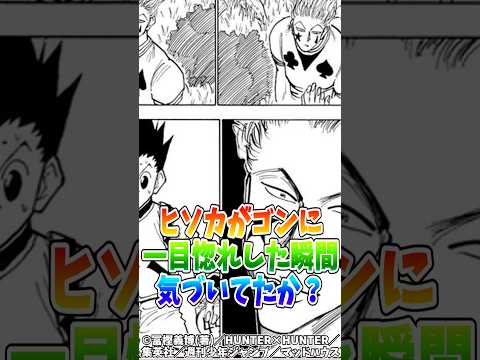
▶ Watch the original YouTube video
Why Hisoka Became Obsessed with Gon in Hunter x Hunter’s Chimera Ant Arc: A Deep Psychological Analysis
In the Chimera Ant arc of Hunter x Hunter, Hisoka’s reaction to Gon’s actions has sparked widespread debate online, with many interpreting it as love at first sight. However, a deeper analysis reveals that Hisoka’s fascination stems from a complex psychological mechanism rooted in his attraction to unpredictability and pure instinct, rather than romantic interest.
What Happened
During the Chimera Ant arc, Gon performs an unexpected action that catches Hisoka’s attention, causing Hisoka’s eyes to visibly sparkle in the anime adaptation. This moment has become the subject of extensive fan discussion, with many interpreting Hisoka’s reaction as romantic attraction. However, the scene represents something far more complex: Hisoka’s fascination with Gon’s unpredictable behavior and pure combat instinct.
Why It Matters
Understanding Hisoka’s true motivation reveals the depth of character psychology in Hunter x Hunter. Rather than dismissing the moment as simple “love at first sight,” recognizing the underlying psychological mechanisms demonstrates how creator Yoshihiro Togashi crafts nuanced character emotions. This distinction is crucial for appreciating the series’ sophisticated character development and the dangerous nature of Hisoka’s obsession with Gon.
Background
Hisoka is characterized as a battle-obsessed fighter who values unpredictability and pure combat instinct above all else. Throughout the series, his reactions to other characters have been consistently tied to their ability to surprise him or demonstrate raw fighting ability. The Chimera Ant arc marks a pivotal moment where Gon’s actions—performed in a state of absolute desperation—trigger an unusually intense response from Hisoka, leading to widespread speculation about the nature of his feelings.
Key Points
- Hisoka’s eyes visibly sparkle when Gon performs an unexpected action, a deliberate artistic choice by the animation team
- Online communities interpret this moment as “love at first sight,” but the reaction is more accurately described as excitement over unpredictability
- Hisoka’s fascination stems from Gon’s ability to surpass his predictions and act on pure instinct rather than calculation
- Gon’s actions occur while in a vulnerable state, yet he manages to outmaneuver Hisoka—an outcome Hisoka did not anticipate
- Hisoka shows no comparable reaction to other powerful opponents like Chrollo, suggesting Gon’s unpredictability is uniquely stimulating
- The psychological mechanism at work is obsession with the unpredictable, not romantic love
Perspectives
The “Love at First Sight” Interpretation: Many fans and online communities interpret Hisoka’s sparkling eyes as a sign of romantic attraction, comparing it to similar scenes in romance anime. This interpretation has become the dominant narrative on social media platforms like Twitter.
The Combat Excitement Theory: Other analysts argue that Hisoka’s reaction is purely about his love of battle and his excitement at encountering an opponent who can surprise him. This view emphasizes Hisoka’s character consistency as someone motivated solely by combat thrills.
The Psychological Obsession Perspective: A deeper analysis suggests that Hisoka’s fascination represents an unhealthy obsession with treating Gon as an unsolvable puzzle. In this interpretation, Hisoka views Gon not as a person but as a mystery to be solved, which is a dangerous psychological pattern.
Comparative Analysis with Other Characters
Examining similar character dynamics across anime reveals patterns in how creators depict obsession versus love. In Attack on Titan, Eren Yeager shows intense reactions to enemies who act unpredictably, but his responses blend hostility with excitement. In Code Geass, Lelouch’s fascination with Suzaku centers on his inability to predict his rival’s actions. In contrast, Hisoka’s response to Gon appears to be pure excitement without the hostile component, distinguishing it from these comparable dynamics.
Togashi’s previous work in Yu Yu Hakusho demonstrates his consistent approach to depicting character psychology through visual cues. The sparkling eyes motif in Togashi’s works typically signals a shift in a character’s internal state, but the specific quality of the sparkle varies depending on the emotion being conveyed. In Hisoka’s case, the sparkle represents intellectual and combat excitement rather than romantic interest.
Online Community Response
Twitter discussions predominantly frame Hisoka’s reaction as romantic, with the equation “sparkling eyes = falling in love” becoming widespread. However, discussion threads on 4chan and Reddit’s anime communities present more nuanced debates, with users arguing about whether Hisoka’s interest is sexual, combative, or psychological in nature.
YouTube comments reveal a more analytical approach, with viewers proposing that Hisoka’s obsession stems from Gon being an “unsolvable puzzle” or suggesting that their relationship resembles a mentor-student dynamic rather than romantic interest.
The Distinction Between Obsession and Love
A critical distinction emerges when examining Hisoka’s behavior: his fascination with Gon represents obsession rather than love. Obsession involves treating another person as an object of fascination or a problem to solve, while love involves genuine care for another’s wellbeing. Hisoka’s interest in Gon centers entirely on Gon’s unpredictability and combat potential—characteristics that serve Hisoka’s own desires rather than Gon’s welfare.
This psychological pattern mirrors dynamics seen in other complex anime relationships, such as Shinji and Kaworu’s connection in Neon Genesis Evangelion, where attachment and genuine emotion become difficult to distinguish. However, in Hisoka’s case, the evidence points more clearly toward obsession with the unpredictable rather than genuine emotional connection.
Insights
Hisoka’s reaction to Gon in the Chimera Ant arc represents a masterclass in nuanced character psychology. Rather than reducing the moment to simple romantic attraction, recognizing the complexity of Hisoka’s motivation—his fascination with unpredictability, his obsession with the unsolvable puzzle that is Gon, and his pure excitement at encountering an opponent who defies prediction—demonstrates the sophistication of Togashi’s character writing.
This distinction matters because it reveals the potentially dangerous nature of Hisoka’s interest in Gon. An obsession rooted in treating another person as a mystery to solve is fundamentally different from and more troubling than romantic love. It suggests that Hisoka views Gon not as a person deserving of care, but as an intellectual and combat challenge to be conquered.
For viewers engaging with Hunter x Hunter, this analysis encourages a deeper appreciation of how visual storytelling—particularly the deliberate use of eye sparkles—conveys complex emotional states. The series rewards careful observation and psychological analysis, revealing layers of meaning beneath surface-level interpretations. As the narrative continues to develop, the relationship between Hisoka and Gon will likely continue to evolve in ways that challenge simplistic categorizations, further demonstrating why Hunter x Hunter remains a compelling study in character psychology and emotional complexity.