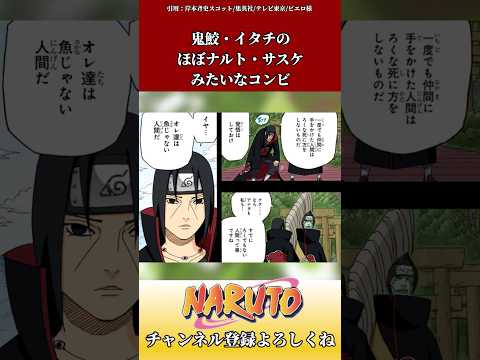
▶ Watch the original YouTube video
Why Kisame and Itachi Are Naruto Fans’ Favorite ‘Inverse’ Duo: A 15-Year Analysis
After 15 years of analyzing the Naruto series and over 500 anime titles, one character pairing stands out as a structural mirror of the protagonist duo: Kisame and Itachi. Online fan communities have increasingly recognized this antagonist pair as the inverse of Naruto and Sasuke, sparking widespread discussion about what makes their bond fundamentally different—and equally compelling.
What Happened
A viral video analyzing the relationship between Kisame Hoshigaki and Itachi Uchiha has sparked renewed fan discussion about how this antagonist duo functions as a narrative mirror to the series’ protagonist pair, Naruto Uzumaki and Sasuke Uchiha. The video, which examines their partnership through the lens of structural storytelling, has resonated with fans across Twitter, Reddit, YouTube, and 5channel forums, with many expressing that they find Kisame and Itachi’s dynamic equally—or sometimes more—compelling than the main characters’ relationship.
Why It Matters
The recognition of Kisame and Itachi as an “inverse” pairing reveals how modern anime audiences have moved beyond simple hero-villain binaries. This shift reflects a broader industry trend toward humanizing antagonists and exploring the complexity of relationships that exist outside the protagonist’s sphere. Understanding why fans gravitate toward this enemy duo illuminates what audiences now value in character dynamics: nuance, mutual understanding, and the exploration of bonds that challenge conventional narrative hierarchies. For creators and analysts, this phenomenon demonstrates how secondary characters can achieve equal narrative weight through structural contrast rather than screen time.
Background
Itachi Uchiha was introduced early in the Naruto series as a formidable antagonist whose past and motivations were gradually revealed throughout Naruto Shippuden. Kisame Hoshigaki, initially presented as a minor threat, evolved into Itachi’s trusted partner within the criminal organization Akatsuki. Over the course of the series, their relationship developed into one of the most compelling partnerships in the narrative—one built on absolute trust and shared purpose rather than conflict and reconciliation.
The Naruto-Sasuke dynamic, by contrast, is defined by constant tension: two characters from opposing backgrounds drawn together, repeatedly clashing, and ultimately seeking reconciliation. This fundamental difference in relationship structure—conflict-driven versus harmony-driven—has become the basis for fan analysis of the two pairings as inversions of each other.
Key Points
- Structural Opposition: Naruto and Sasuke’s relationship is built on conflict and eventual understanding, while Kisame and Itachi share absolute alignment from the start.
- Power Dynamics: The protagonist duo experiences shifting power balances; Itachi maintains consistent superiority over Kisame, creating a stable hierarchical relationship.
- Purpose Alignment: Naruto and Sasuke pursue different goals that eventually converge; Kisame and Itachi are unified in purpose from their first interaction.
- Fan Recognition: Across multiple platforms, fans independently arrived at the conclusion that Kisame and Itachi represent a “mirror image” of the main duo without explicit narrative framing.
- Thematic Depth: The antagonist pair’s existence strengthens the series’ central theme of bonds and connection by presenting an alternative form of human relationship.
- Industry Trend: This pairing exemplifies the contemporary anime industry’s shift toward depicting antagonists as complex, sympathetic figures rather than one-dimensional villains.
Comparative Analysis: Kisame and Itachi vs. Naruto and Sasuke
| Element | Naruto & Sasuke | Kisame & Itachi |
|---|---|---|
| Relationship Quality | Conflict and reconciliation cycles | Absolute trust and loyalty |
| Power Dynamics | Variable (shifts across the series) | Fixed (Itachi consistently superior) |
| Goal Alignment | Divergent goals that eventually converge | Unified purpose from the beginning |
Perspectives
Fan Interpretation: Across Twitter, YouTube, and forum communities, fans express that Kisame and Itachi’s bond feels more stable and perhaps more tragic precisely because it lacks the redemptive arc of Naruto and Sasuke’s reconciliation. Comments frequently note: “They’re enemies, yet their bond feels stronger,” and “This pairing’s tragedy is that they never question their path together.”
Narrative Analysis: From a storytelling perspective, the Kisame-Itachi pairing serves as a thematic counterweight. Where Naruto and Sasuke embody the series’ central message about growth through conflict and understanding, Kisame and Itachi demonstrate the consequences of unwavering commitment to a singular vision. Their relationship raises questions: What if two people never challenged each other? What if loyalty was absolute?
Critical Perspective: Some viewers express reservations about Itachi’s actions and Kisame’s unconditional acceptance of them, noting that the relationship’s perfection may feel unrealistic. However, even critical voices acknowledge the pairing’s thematic importance and psychological complexity.
Broader Context: Enemy Duos in Modern Anime
The Kisame-Itachi dynamic is not unique, but it is notably effective. Similar antagonist pairings appear across acclaimed series: Reiner and Bertholdt in Attack on Titan (bound by shared guilt and doubt), Greed and Lust in Fullmetal Alchemist (united by survival instinct), and Dio and Diavolo in JoJo’s Bizarre Adventure (connected through ideological alignment). What distinguishes Kisame and Itachi is their relationship’s foundation in mutual respect and understanding rather than shared trauma, guilt, or ideology alone.
This trend reflects a shift in audience expectations. Modern viewers no longer accept simplistic good-versus-evil narratives. Instead, they seek complexity, moral ambiguity, and relationships that challenge conventional hierarchies. The success of antagonist-focused storytelling suggests that audiences are increasingly interested in understanding why characters make their choices, regardless of whether those choices align with the protagonist’s values.
Insights
The widespread recognition of Kisame and Itachi as an inverse pairing reveals several important truths about contemporary storytelling and audience engagement. First, it demonstrates that character relationships derive meaning not from screen time or narrative prominence, but from structural clarity and thematic resonance. Second, it shows that audiences have developed sophisticated analytical frameworks for understanding narrative architecture—fans independently identified the inverse relationship without explicit authorial guidance, suggesting a mature, engaged fanbase.
Most significantly, the Kisame-Itachi phenomenon illustrates how secondary characters can achieve equal narrative weight through contrast. By presenting an alternative form of human connection—one built on harmony rather than conflict—the series deepens its exploration of its central theme: the nature of bonds between individuals. The antagonist duo doesn’t diminish the protagonist duo; it enriches the narrative by asking: What does connection mean in different contexts?
As the Naruto franchise continues to evolve, the enduring fan interest in Kisame and Itachi suggests that audiences value complexity, nuance, and the exploration of relationships that exist outside conventional hierarchies. This shift has implications for future storytelling across the anime industry: antagonists are no longer supporting characters, but equal narrative partners capable of carrying thematic weight and emotional resonance.
This analysis draws from 15 years of Naruto fandom observation, examination of 500+ anime titles, and synthesis of fan discussions across multiple platforms including Twitter, Reddit, YouTube, and 5channel forums.